
Your word is a lamp to my feet and a light for my path. (Psalm 119:105)
Psalm 43 (NIV, 1984)
1 Vindicate me, O God,
 	and plead my cause against an ungodly nation;
 	rescue me from deceitful and wicked men.
2 You are God my stronghold.
 	Why have you rejected me?
  Why must I go about mourning,
 	oppressed by the enemy?
3 Send forth your light and your truth,
 	let them guide me;
  let them bring me to your holy mountain,
 	to the place where you dwell.
4 Then will I go to the altar of God,
 	to God, my joy and my delight.
   I will praise you with the harp,
 	O God, my God.

5 Why are you downcast, O my soul?
 	Why so disturbed within me?
  Put your hope in God,
 	for I will yet praise him,
 	my Saviour and my God.
Notes
1. Psalm 43 is a lament that is addressed to God. Although the psalmist complains that God has rejected him it is done without bitterness as he is more concerned that he has been misjudged. He wants to be vindicated but recognises that his priority is to maintain his relationship with his God.
Psalm 43 – lament layout
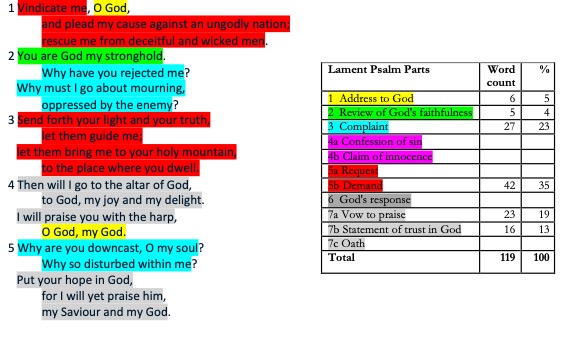
2. The poetic structure is straightforward to discern. It has three stanzas in a chiastic pattern. Stanza 2 is a single line strophe in the centre while Stanzas 1 and 3 each have 4 strophes in matching reverse order.
Psalm 43 (NIV, 1984)
Seek vindication when misjudged but only in the context of continuing to ‘dwell with Yahweh.’
| Stanza 1 | When misjudged we should turn to God | |
| Strophe A | 1 Vindicate me, O God, and plead my cause against an ungodly nation; rescue me from deceitful and wicked men. | Request for God’s help so he is seen to be in the right and is not doing anything wrong. |
| Strophe B | 2 You are God my stronghold. Why have you rejected me? | Feels very lonely and weak so senses that God has given up on him. |
| Strophe C | Why must I go about mourning, oppressed by the enemy? | Downhearted from both his troubling thoughts and the opposition he is experiencing. |
| Strophe D | 3 Send forth your light and your truth, let them guide me; | Nevertheless, recognises he needs God’s guidance and instruction. |
| Stanza 2 | ‘Dwelling’ with Yahweh is the place to be | |
| Strophe X | let them bring me to your holy mountain, to the place where you dwell. | ‘Dwelling with Yahweh’ is about living life focussed on Yahweh. |
| Stanza 3 | We need to focus on Yahweh even in the midst of troubles | |
| Strophe D1 | 4 Then will I go to the altar of God, to God, my joy and my delight. | His focus is on Yahweh, not on himself or even on Yahweh’s help or gifts. |
| Strophe C1 | I will praise you with the harp, O God, my God. | He will still praise God out loud even while in such trouble. |
| Strophe B1 | 5 Why are you downcast, O my soul? Why so disturbed within me? | Aware that his feelings are not a good measure of his life’s value and meaning. |
| Strophe A1 | Put your hope in God, for I will yet praise him, my Saviour and my God. | He senses that Yahweh’s presence is more important than his circumstances. |
3. In strophe A the psalmist describes the trouble he was having with people (‘an ungodly nation’ and ‘deceitful and wicked men’) who had some sort of control over him. He wants ‘vindication’ – an acknowledgment that he was not doing anything wrong but actually was behaving righteously and correctly. He ought to be treated better!
4. That opposition from without causes him to have inner doubts about himself and God. He feels weak and on his own and is beginning to think that God, his ‘stronghold,’ has also turned against him (strophe B).
5. He is therefore downhearted and sad (‘I go about mourning’) because of ‘the enemy’ – and that enemy is not just the outer opposition for it also includes his inner sense of despair (strophe C).
6. This is a very real and true-to-life description of what we nowadays call ‘stress’ or ‘trauma,’ depending on how severe it is, for as well as the trouble he has from other people his inner sense of who he is has been disturbed.
7. But the psalmist knows what to do (strophe D) – he calls on God to send his ‘light and truth’ that will ‘guide’ him. That will enable him to survive, help him overcome and hopefully put right the situation that is being managed so badly by the opposition. That would be an aspect of his ’vindication.’
8. That is all in stanza 1, the first part of the Psalm. It is a poetic and true description of what happens to us when such troubles hits us. The godly psalmist knows what to do so he calls on God for help. It is true that he wonders if God has rejected him but he still calls on God! That tells us he has not lost his faith. His sense of rejection by God is a ‘normal’ aspect of the way we react to stress and trauma.
9. A key feature of Old Testament poetry, that was written in ancient Hebrew, is parallelism between ideas, so the ideas A, B, C and D in Stanza 1 are matched by ideas D1, C1, B1 and A1 (in reverse order) in Stanza 3 but whereas Stanza 1 is about his experiences and his reaction to his problems, which are ‘normal’ and common, in Stanza 3 he describes an additional godly approach to how we should handle such troubles that stress and traumatise us.
10. This third stanza teaches that, even in the middle of stressful circumstances we should focus, not on the trouble, but on Yahweh, our God, the God who is, ‘Always I am.’ That is the meaning of God’s name, Yahweh. It is the name God gave to Moses to use. That name is a reminder that God is always present, always caring, all knowing and always available. It is so easy when we go through times of trouble to focus on our troubles, but the psalmist has found a better way.
11. Interestingly, although God’s name, Yahweh, is by far the commonest way God is addressed throughout the OT, the psalmist does not use it here.
12. Rather than just asking God to help him cope with his troubles as in strophe D he makes a point in strophe D1 of actively focussing on God. He uses the imagery of going to the tabernacle (that was replaced by King Solomon by the Temple) in Jerusalem, where the ‘altar’ was, as a metaphor for worshipping God, He does so with ‘joy and delight’ and not in fear, anxiousness or doubt that his troubles cause, for Yahweh is so real and vibrant, unfailingly caring and present. That is more important to him than his troubles.
13. In contrast to his ‘mourning’ in strophe C as a reaction to his troubles, in strophe C1 he worships God with music, playing a harp so that implies he was singing too! That would be out loud. Was it communal worship? It does not say, but that can be implied by his reference to ‘go to the altar of God’ where undoubtedly other people would gather. This does not change his circumstances, but it most certainly changes his attitude.
14. As result, he sees his feelings about loneliness and weakness as in strophe B differently, for he speaks to himself with a challenge in strophe B1, ‘why are you downcast, why are you so disturbed?’ Yahweh has not changed! Yahweh is still present and caring. He is in control and knew exactly what he was going through. And Yahweh is God Almighty, the Creator and Sustainer of the universe so, in truth, he is ultimately responsible for everything that happens whether good or bad. That means, therefore, that God does not have to answer to us, explain or justify what is happening. He calls us to trust him even in the storms of life. We cannot trust our feelings or our opinion about what ought to happen – but we can trust Yahweh, Almighty God – wholeheartedly.
15. As a result, rather than looking for ‘vindication’ as in strophe A, valid as that is, the psalmist in strophe A1 chooses to trust Yahweh. He puts his hope in him but because he is addressing himself (my soul), the words speak so much more powerfully as if he is addressing us, his modern-day readers.
16. Finally, we turn to stanza 2, in the centre of the psalm. It is a single strophe that is designated as strophe X as it is the crux, the main point of the psalm. ‘Your holy mountain’ refers to the tabernacle and the later Temple, that were often set on an elevated place both physically and metaphorically. It was where Yahweh ‘dwelt,’ but Yahweh exists outside of time and place. Yahweh cannot be contained in a Temple, a shrine or any other sacred place. Yahweh is everywhere; he is with everyone, so this is a metaphor for focussing on Yahweh wherever we are and whatever is happening.
17. ‘Dwelling’ with Yahweh is a theme in the Bible. I explore it in relation to Psalm 91 and it has close parallels with such New Testament teaching as living for Jesus, living by faith and being ‘in Christ.’
18. Psalm 43 accurately describes what we go through in our inner being when we experience unwarranted troubles in life and includes a spiritual response of bringing our troubles to God, seeking his comfort, support and especially his guidance in surviving and coping.
19. Then it goes further and encourages us to lift our eyes from our troubles and how we feel, to focus on our God, who never leaves or forsakes us. He is with us and in us at all times whatever our circumstances. This is the same teaching that we read about in the New Testament. See, for example:
… I have learned to be content whatever the circumstances. I know what it is to be in need, and I know what it is to have plenty. I have learned the secret of being content in any and every situation, whether well fed or hungry, whether living in plenty or in want. I can do everything through him who gives me strength (Philippians 4:11-13).
And:
… be content with what you have, because God has said,
 	‘Never will I leave you;
 	never will I forsake you.’
So we say with confidence,
 	‘The Lord is my helper; I will not be afraid.
 	What can man do to me?’
… Jesus Christ is the same yesterday and today and for ever.
… Through Jesus, therefore, let us continually offer to God a sacrifice of praise – the fruit of lips that confess his name. And do not forget to do good and to share with others, for with such sacrifices God is pleased (extracts from Hebrews 13: 5-16).
20. Although I am publishing my findings now the study is incomplete without more detailed analysis.
21. Why is Yahweh not mentioned by name? Are any clues discernable?
22. There are some similarities with Psalm 42 so some Bible scholars wonder if they should be considered as one Psalm. I am satisfied that studying them separetely provides a satisfactory assesment so it needs fresh eyes and mind to consider an alternative. Why not have a go? Please report back and your findings can be referenced or even published here.
Written: 8 June 2016
Published: 12 August 2026