
Your word is a lamp to my feet and a light for my path. (Psalm 119:105)
1. Joel’s Message 3 mainly refers to the army invasion, although the locusts do get a mention, but all that is merely an introduction to the main topics of Yahweh’s ministry of recovery and healing and his retribution on those who have rejected his rule and hurt his people.
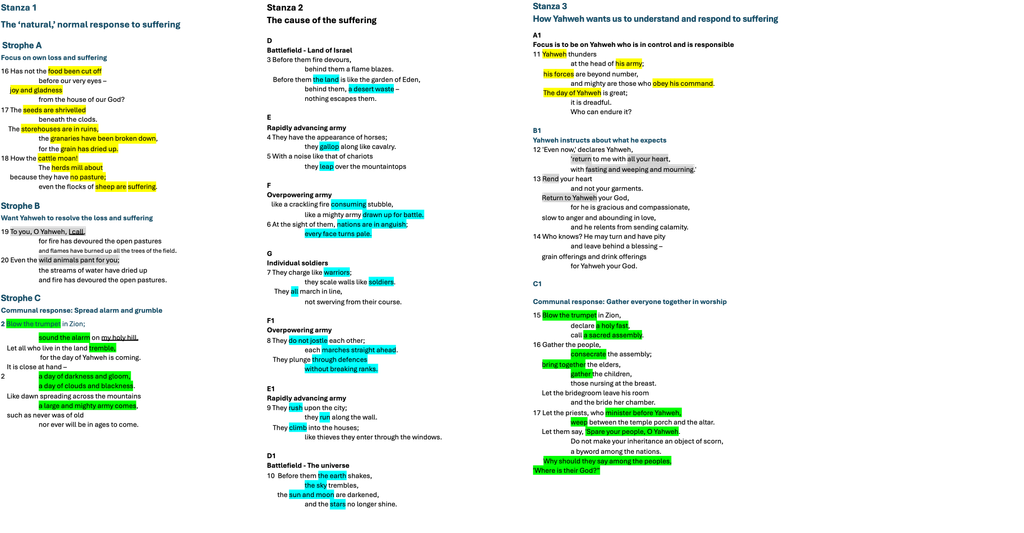
2. It is a single-stanza Message that is arranged chiastically into seven strophes: A-B-C-X-C1-B1-A1.
3. For us, Joel’s readers in the 21st century, this is a Message about living the life of a Yahweh follower and it is all about Yahweh – his attitude toward his followers when they go astray and his ministry of recovery and healing that contrasts with his retribution against those who reject him.
Poetic structure
| Strophe A Yahweh’s promise of recovery 18 Then Yahweh will be jealous for his land and take pity on his people. 19 Yahweh will reply to them: ‘I am sending you grain, new wine and oil, enough to satisfy you fully; never again will I make you an object of scorn to the nations. |
4. Strophe A describes Yahweh’s jealousy (meaning fierce protectiveness, not envy) for the safety and welfare of his land and his people. That is expressed in his promise to bring ‘grain, wine and oil,’[1] the basic necessities for life, that will ‘satisfy fully.’ He promises that never again will he allow the nation to be treated badly. This is a Covenantal promise. It is not an uncommon promise in Scripture and as we well know, Yahweh’s people, then and now, fail repeatedly to keep their side of the Covenant. But ‘God cannot be mocked. A man reaps what he sows,’ (Galatians 6:7). So, the nation does subsequently go through times of trouble. God’s promises are always conditional on our responsiveness. Our calling and responsibility are to trust Yahweh and live lives that seek to honour and worship him. If we fail to do that, we cannot expect Yahweh to continue to bless, encourage and help us. However, Yahweh is patient, merciful, gracious and kind so welcomes us back as we repent and renew our commitment. We learn about that in later strophes.
| Strophe B Yahweh deals with the invading army 20 ‘I will drive the northern army far from you, pushing it into a parched and barren land, with its front columns going into the eastern sea and those in the rear into the western sea. And its stench will go up; its smell will rise.’ |
5. Strophe B describes how Yahweh will deal with the invading army. Initially this appears to be about the locust invasion that Yahweh will drive into ‘a parched and barren land’ – an area where there was no vegetation to feed on – some drown in the eastern sea (Dead Sea), and others drown in the western sea (Mediterranean Sea). All that is left is the smell of their rotting bodies.
6. But notice that the strophe refers to this invading horde as ‘the northern army.’ Locusts would never come from temperate northern climes but only from the arid south. This phrase therefore must be a metaphorical reference to a human army and that, therefore, would refer to the Assyrians, the major empire of the day that was in the north, in an area that roughly equates with modern Turkey.
7. Israel and the neighbouring nations were all small and none threatened the might of Assyria, but they occupied the land at the eastern end of the Mediterranean Sea that was the land bridge between Africa in the south with its Egyptian Empire and Europe and Asia in the north with their locally dominant Assyrian Empire. Egypt and Assyria were major rival powers so Israel occupied their key battleground.
8. This is the strongest hint yet, that Joel’s teaching about the locust invasion, though very real in itself, was also a metaphor about the anticipated Assyrian army invasion.
| Strophe C Yahweh’s harvest blessings on the land and people Surely he has done great things. 21 Be not afraid, O land; be glad and rejoice. Surely Yahweh has done great things. 22 Be not afraid, O wild animals, for the open pastures are becoming green. The trees are bearing their fruit; the fig tree and the vine yield their riches. 23 Be glad, O people of Zion, rejoice in Yahweh your God, for he has given you the autumn rains in righteousness. He sends you abundant showers, both autumn and spring rains, as before. 24 The threshing floors will be filled with grain; the vats will overflow with new wine and oil. |
9. Strophe C refers to Yahweh’s harvest blessings on the land and the people. This addresses the key need for the people at this stage in their history, for they were dependent on the cultivation of the land for their survival. One missed harvest could lead to starvation and any more than that to famine. The extra details about satisfying the needs of ‘wild animals’ (Cf Psalm 147, note 16) and the mention of productive fruit trees, figs and vines would be additional encouragement that all the nutritional needs of wild animals, their flocks and herds, as well as the people themselves, would be met in abundance.
10. There is also the reassurance that the perennial concern about the continuation of seasonal rains was being addressed. That may be particularly relevant if the hint about a drought in association with the locust plague is true (Message 2, note 11).
11. And note that the present tense is used – this was already happening! All this would eventually lead (the future is now referenced) to full threshing floors and overflowing vats so, quite rightly, Joel calls the people to, ‘Be glad,’ and, ‘rejoice in Yahweh your God!’ This was not coincidence or good fortune, but due to the kindness, care and interest of Yahweh. What a lesson for our world!
12. These three strophes, A, B and C, are all about Yahweh’s interest, concern and promises to his people and they lead into the central strophe X.
| Strophe X Yahweh restores his relationship with his people in his land 25 ‘I will repay you for the years the locusts have eaten – the great locust and the young locust, the other locusts and the locust swarm – my great army that I sent among you. 26 You will have plenty to eat, until you are full, and you will praise the name of Yahweh your God, who has worked wonders for you; never again will my people be shamed. 27 Then you will know that I am in Israel, that I am Yahweh your God, and that there is no other; never again will my people be shamed. |
13. Here, Yahweh speaks about restoring his relationship with his people in his land. This is not, of course, in any sense, an apology that Yahweh is making up for his mistake in the suffering he brought on his people. The people’s suffering was due to their own wilful sinfulness in rejecting Yahweh’s guidance, wisdom and instructions. Rather, it reflects Yahweh’s compassion and willingness to forgive and start again. Yahweh is consistent for he treats us in the same way.
14. The strophe consists of three lines that are set in an unusual form. The key to this is the parallelism between the line-parts. Each line has four parts, the first and fourth match as do the second and third. This structure is a poetic tool that makes the strophe stand out, emphasising its role as the central and key truth that Joel’s Message 3 wishes to impart. Cleverly, it reverts to the imagery of the locust invasion, for that was still a key concern even as Yahweh’s people faced the terror-inducing prospect of the invading Assyrian army.
15. And that is a reminder for us that stress, trouble and trauma are a natural feature of human existence. Railing against these events is not helpful. Nor is trying to explain and understand them as in the philosophical ideas described in the theological topic of theodicy.[2] After all, if we attained such understanding that is aimed for, it would lead to a sense of control – but that is Yahweh’s role, not ours.
16. Yahweh himself speaks in this strophe, emphasising the importance of its teaching. Notice:
a. ‘I will repay you’ – is not about settling a debt. The word used (salem) can be translated into dozens of different English words and phrases with the sense of completion and peace.[3]
b. ‘my great army that I sent’ –both the locust plague and the Assyrian army were under Yahweh’s control though the Assyrians themselves were probably unaware of this.
17. Cheek by jowl with that is Yahweh’s assurance of his love, care and commitment to his people. Notice:
a. ‘You will have plenty to eat, until you are full’ – he will satisfy their needs in abundance.
b. ‘never again will my people be shamed’ – this phrase is repeated to indicate its importance and it is ‘shamed’ not ‘ashamed.’ To be shamed means to be subjected to ridicule or contempt whether or not there are any grounds for such behaviour. To be ashamed, however, refers to personal feelings of guilt or regret. So, this is not about their sinfulness or waywardness but about how they were perceived by other nations.
18. Never again’ is a phrase that occurs 39 times in Scripture and on about 30 occasions it refers to Yahweh’s promise to ‘never again’ punish his wayward people. It appears to be an unconditional promise on many occasions, so it is tempting to read it as such on every occasion as rarely are any qualifications given – but that is to miss the point. Such statements are not legal promises but instead are based on Yahweh’s Covenants.[4] Scripture invariably focuses on Yahweh’s role as that needs emphasis as it is radically different to the covenants people made with their tribal gods and human leaders to ensure their leadership, guidance and protection. But everyone knew what was expected in return, in all such covenants whether the covenant was with a human ruler, a tribal god or Yahweh himself: obedience, respect and honour. And if those conditions were not met there would be serious repercussions. As Yahweh was, and is, omnipotent, omniscient and omnipresent it would be foolish in the extreme to think it could be possible for them or us to ignore, short-change, modify or seek to negotiate the terms of the covenantal responsibilities Yahweh expects of his people.
19. The final part of the Message (strophes C1, B1 and A1), where the three strophes match the first three but in reverse order, moves on from the physical blessing of harvest and land to Yahweh’s role in spiritual blessing.
| Strophe C1 Yahweh’s spiritual blessings for all a 28 ‘And afterward, I will pour out my Spirit on all people. b Your sons and daughters will prophesy, your old men will dream dreams, your young men will see visions. c 29 Even on my servants, both men and women, I will pour out my Spirit in those days. d 30 I will show wonders in the heavens and on the earth, blood and fire and billows of smoke. e 31 The sun will be turned to darkness and the moon to blood before the coming of the great and dreadful day of Yahweh. f 32 And everyone who calls on the name of Yahweh will be saved; g for on Mount Zion and in Jerusalem there will be deliverance, as Yahweh has said, h among the survivors whom Yahweh calls. |
20. Whereas Strophe C focuses on physical blessings for Yahweh’s special people, Israel, Strophe C1 focuses on Yahweh’s spiritual blessings for all his created beings.
21. Notice that this amazing and stunning promise of an outpouring of Yahweh’s Spirit is promised to ‘all people’ (basar) in line a. It is not limited to ‘my people’ (am) as is used in the last line of strophe X. The usual Hebrew for ‘people’ (am) refers to people in relationship as in ‘my people’ but a different word is used in strophe C1. On this occasion the word (basar) refers to ‘flesh’ so translators have more than twenty English words to consider using. The context here suggests it refers to all people everywhere and at any time. So yes! Yahweh is speaking here to everyone, everywhere and at any time in history.
22. Yahweh’s promise is then expanded in lines b and c to include ‘sons and daughters,’ ‘old men’ and ‘young men’ and on Yahweh’s ‘servants, both men and women.’ These named groups are those that are most easily sidelined (something similar happens in Message 2 note 45 when some unusual groups are listed to make a point). This is a powerful and positive poetic technique to emphasise that no one was excluded. Notice that priests, prophets and community leaders are not specifically mentioned as might be expected. The blessing of Yahweh’s Spirit would not be limited to spiritual leaders or a special elite, whether religious or secular. Here is a foretaste of the Pentecostal blessing described in Acts 2 and explained in Ephesians 1:3-14. Poetically these community groups were not mentioned to single them out but to illustrate that these most unlikely groups were included. This blessing was for all!
23. The central two lines d and e refer to cataclysmic cosmic events. There have perhaps been hints of this in the description of the locust invasion (Message 2, strophe C and D1), that can now be seen as having a secondary role in preparing the people for these revelations in Joel’s Message 3. Also, they have a role in preparing Joel’s audience for further revelations in Message 4. Similarly phrased prophesies are made in Isaiah 13:10 and 34:4 and Jesus references them in Mark 13:24-25 and Luke 21:11. They are all associated with the Day of Yahweh.
24. Peter quotes some of this passage in his sermon at Pentecost (Acts 2:17-21) but neither at Pentecost nor in Joel’s recorded experience does there appear to have been a complete fulfilment. Hence the widely held assumption is that the fulfilment is still to come and will feature at Jesus’ return.
25. We do need to be careful here for that does not mean it will be possible as that Day approaches for Bible students to know exactly when and how the Day of Yahweh will occur. Remember that Jesus said, ‘No one knows about that day or hour, not even the angels in heaven, nor the Son, but only the Father’ (Mark 13:32).
26. These revelations are not intended to give us advance notice. Instead, they reassure us that whatever awful things are going on in nature or in international affairs, Yahweh is in ultimate control.
27. It is fascinating to note that when Peter quotes Joel 2: 31 he refers to the day as ‘glorious’ and not ‘dreadful.’ That is apt for it is a godly perspective and fits in with NT revelations about the Day of Yahweh and is not the usual self-centred, fear inducing focus on the destructive ending of the world and unbelieving humanity as we know it.
28. Peter, though, was not misquoting Scripture. He was quoting a Greek translation of the original Hebrew that had been developed some centuries after Joel’s time, so it looks as if the translators had begun to understand something about the revelation of Yahweh’s plans that would become clear only after the Pentecost of Acts 2. The version Peter quoted was in the Septuagint,[5] the Koine Greek[6] version of the OT that was translated from the original Hebrew in the period 250-100 BC. This was an important development making Scripture available in the language which was spoken throughout the Middle East among both Jews and Gentiles, There were large Jewish settlements throughout the Middle East and many were recovering the faith of their forefathers but were far more familiar with Koine Greek, the lingua franca of the Eastern Mediterranean and especially the Roman Empire, and Aramaic, that was predominant in Judea, especially among the less well educated, than they were of their own Hebrew language.
29. It is not directly relevant to this study but notice that this means that the OT Scriptures were readily available right from the beginning of the church. What a stunning blessing that would have been! Surely, it is one aspect of the arrangements that contributes to Yahweh’s overall plan for the coming of Jesus as Galatians 4:4 explains:
But when the time had fully come, God sent his Son, born of a woman, born under the law, to redeem those under the law, that we might receive the full rights of sons.
30. The final three lines, f, g and h, express Yahweh’s heart for the people he created. His promise is that ‘everyone who calls on the name of Yahweh will be saved.’ Paul quotes that promise in Romans 10:13 at the culmination of his explanation that the good news of salvation was for both Jews and Gentiles, the two major sections of Paul’s society.
31. The reference to ‘Mount Zion and Jerusalem’ would have encouraged Joel’s audiences for these places were central to the religious and communal life of the nation.
32. The final line h contrasts with the first, line a, as it refers to ‘survivors.’ This suggests that not all will be saved, apparently contradicting the first line’s, ‘all people.’ Statements such as these are part of the Covenant Yahweh has with his created beings. Yahweh’s people have a part to play. That requires them to fulfil Yahweh’s expectations of obedience and commitment. If they fail to do that, they are breaking the terms of the Covenant and will suffer the consequences.
33. Furthermore, this illustrates the division that divides theologians. Some believe that salvation is for ‘whoever will may come’ (John 3:16), others proclaim it is for those whom God calls (Ephesians 1:4-5) and others see it as a combination. A simple but reasonably satisfactory understanding is to see salvation as a doorway. As we approach, we see a welcome sign, ‘whoever will may come,’ so we choose to go through. But if we then turn and look back at the same doorway, we see a sign that says, ‘chosen from before the creation of the world.’ The Bible promotes both views, so it is not a matter of ‘either or’ but of ‘both and’.
| Strophe B1 Yahweh deals with the nations 1 ‘In those days and at that time, when I restore the fortunes of Judah and Jerusalem, 2 I will gather all nations and bring them down to the Valley of Jehoshaphat. There I will enter into judgment against them concerning my inheritance, my people Israel, for they scattered my people among the nations and divided up my land. 3 They cast lots for my people and traded boys for prostitutes; they sold girls for wine that they might drink. |
34. The inevitable corollary of Yahweh’s offer of immense blessing, security and help is that those who reject Yahweh’s Covenant will suffer the consequences so in strophe B1 Joel returns to the topic of how Yahweh will deal with the nations who sponsored the invading army of strophe B.
35. I confess I have still been thinking of them as ‘the enemy,’ as that seemed to follow on from the imagery of an invading army in Message 2. But that army is Yahweh’s army (Message 2, notes 36-38) so I have carefully reread all three chapters of Joel, the book, and I confirm that there is no reference to ‘enemy’ or a similar word anywhere. In strophe B the army was defeated and destroyed so now he turns to the nations who sponsored that army and had participated in the way Yahweh’s people had been scattered far and wide, their land had been appropriated and the people enslaved and children and young adults (for both ‘boys’ and ‘girls’ can be used to refer to young adults) were abused sexually.
36. Their comeuppance came after the fortunes of Judah and Jerusalem were restored and Yahweh gathered ‘all nations.’ That suggests this refers to more than those nations who had been antagonistic toward Judah.
37. On three occasions (2:27, 3:2 and 3:16) ‘Israel’ is used instead of Judah. That is potentially confusing as the nation’s name of Israel was taken by the breakaway northern tribes who separated from the southern tribes that were led by descendants of King David who was of the tribe of Judah. However, after the northern kingdom had been taken into Assyrian captivity Judah seems to have made a point of reclaiming the name of Israel (see comment in Psalm 147 note 8). I guess it was a way of reclaiming their association with the Covenant Yahweh initiated with the whole nation in Moses era.[7]
38. This use is one of the reasons for thinking that Joel was written around the time of the Assyrian conquest of the northern kingdom in 722 BC.
39. The nations were brought together in the ‘Valley of Jehoshaphat.’ Such a place is only named on three occasions, all in Joel and there is no evidence of its physical existence in archaeological or other relevant records. Jehoshaphat, the name of a king of Judah means ‘Yahweh is judge’ so it might be better translated as the ‘Valley of Yahweh’s judgement’, That would bring the phrase into line with the ‘Valley of Decision’ and possibly the ‘ravines of Judah’ and ‘the valley of acacias’ that we come to in Message 4.
| Strophe A1 Yahweh’s promise of retribution 4 ‘Now what have you against me, O Tyre and Sidon and all you regions of Philistia? Are you repaying me for something I have done? If you are paying me back, I will swiftly and speedily return on your own heads what you have done. 5 For you took my silver and my gold and carried off my finest treasures to your temples. 6 You sold the people of Judah and Jerusalem to the Greeks, that you might send them far from their homeland. 7 ‘See, I am going to rouse them out of the places to which you sold them, and I will return on your own heads what you have done. 8 I will sell your sons and daughters to the people of Judah, and they will sell them to the Sabeans, a nation far away.’ |
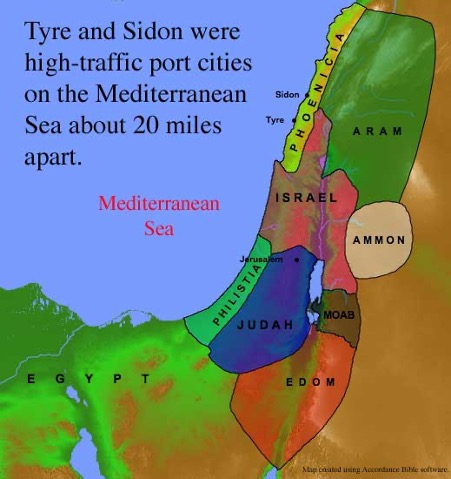

40. In strophe A Yahweh promised recovery for the nation emphasising the abundant crops they would enjoy and in strophe A1 this is parallelled by Yahweh’s promises of retribution on those who had abused his people. Joel presents this point in the form of questions addressed to the people of Tyre, Sidon and Philistia. Geographically, these could not be related to the ‘northern army’ for Tyre and Sidon were port-cities of Phoenicia in what is now Lebanon and Philistia refers to the 5 city-states occupied by the Philistines in the coastal strip further south. 2 Chronicles 21:16-17 and Amos 1:6-10 could well describe the incident Joel refers to. However, although these nations are addressed by Joel, there is no suggestion that they would hear or read this message. The questions are likely to be rhetorical and presented in this form to make the point that such objections are entirely unjustified. So, Yahweh’s proposed punishment of banishment to a distant country as slaves was quite reasonable.
41. The Sabeans were natives of Sheba that is generally considered to be modern Yemen that is some 3,000+ miles away bordering the Arabian Sea – as far to the south from Israel as UK is to the north-west! Sheba was definitely ‘a nation far away.’
42. The Message ends with retribution against those who actively rejected or just neglected to follow Yahweh’s teaching but that is the corollary of the blessing that is received by those who repent and turn to Yahweh and live in the light of his truth – and that is the main topic of the Message.
43. It is all too easy, but intellectually lazy, to see this Message as showing that Yahweh favoured Israel and treated her more favourably than other nations, but this is taking some passages out of the context within the whole of Scripture and especially the OT.
44. In summary: Yahweh’s plans for the salvation and blessing of all nations was to be through Abrahams’s descendants (Genesis 12: 2-3). That was ultimately achieved through Jesus (Hebrews 10:12-31) but before that, God chose the nation of Israel to be an example of godly living and his witnesses to, and interceders on behalf of, other nations (Exodus 19:3-6). The terms of Yahweh’s Covenant with Israel were clearly stated in Deuteronomy 28:1-30:20. Failure to keep their covenantal responsibilities would warrant the severest of punishments, worse than anything other nations would experience.
Main teaching points
45. The tone of Messages 1 and 2 suggests that fear was an underlying feature and there seemed to be a ‘back against the wall’ attitude as the people faced difficult and serious problems, had limited choices and little opportunity to escape. But Message 3 is dramatically different. There is positivity and peace, an assured future and security. The difference is due to seeing the nation’s situation from Yahweh’s perspective. Message 3 show us what life can be like when Yahweh’s people wholeheartedly fulfil their Covenantal responsibilities to obey, respect and honour their God, Yahweh (see note 18).
46. Much of this Message has Yahweh speaking. This is of immense importance, as instead of Joel sharing a message he has received from Yahweh, we hear Yahweh himself revealing his heart of compassion for his people who bear his name and profess to know him and are committed to serve and honour him. But Yahweh’s compassion does not end there. He loves and cares for all humanity and longs for all to turn to him in repentance and trust.
47. The concept of Covenants as a way of describing Yahweh’s relationship with his people is well developed in Scripture in both OT and NT but rarely seems to feature in modern church preaching and liturgy. Should this be reevaluated?
Endnotes
[1] ‘Oil’ refers to the oil from olive trees that was used in cooking, preserving food, as an emollient and in oil lamps.
[2] There is a helpful review of the Bible’s teaching about suffering in R. S. Wallace, ‘Suffering’ in J. D. Douglas, and others, (Ed.) The Illustrated Bible Dictionary, (Leicester: Inter-Varsity Press, 1980), pp 1491-1492, while Alister E. McGrath, Christian Theology: An Introduction, 4th edn., (Singapore: Blackwell Publishing, 2007), pp. 231-235, reviews various philosophical attempts to understand suffering.
[3] William D Mounce, Mounce’s Complete Expository Dictionary of Old and New Testament Words, (Grand Rapids, MI: Zondervan, 2006), p. 579.
[4] ‘Covenant’ is a key descriptor for Yahweh’s relationship with his people. It is enshrined in the very name of the Bible, for ‘Testament’ as in ‘Old Testament’ and ‘New Testament’ is another word for Covenant. There is an excellent review in F. C. Fensham, ‘Covenant,’ in J. D. Douglas, and others, (Eds.) The Illustrated Bible Dictionary, (Leicester: Inter-Varsity Press, 1980) pp.326-331.
[5] New English Translation of the Septuagint (International Organisation for Septuagint and Cognate Studies, Inc:, 2007) available at: https://ccat.sas.upenn.edu/nets/edition/. Used by permission of Oxford University Press. All rights reserved. See also Wikipedia, ‘Septuagint’ for an introduction, https://en.wikipedia.org/wiki/Septuagint [accessed 28 June 20206]. Bear this in mind when you come across other OT quotations in the NT that do not match what the OT text says in your usual translation.
[6] Koine (=common) Greek was not the Classical Greek used by the Greek philosophers of 500-300 BC but was a simplified version that developed during the reign of Alexander the Great and was the lingua franca throughout the Eastern Mediterranean until about 600 AD.
[7] Irvin A. Busenitz, Joel & Obadiah, A Mentor Commentary, (Fearn, Ross-shire: Christian Focus Publications, 2003) pp.18-20
Written: 6 April 2025
Published: 15 October 2026
Click on the link to go to Message 4.