
Your word is a lamp to my feet and a light for my path. (Psalm 119:105)
1. Joel’s second Message expands on the first Message as it describes reactions to the locust invasion with some hints about an impending, literal, army invasion. It describes the natural and secular reaction to such overwhelming trauma – how the people did react and how they were likely to react in the future – and compares that with Yahweh’s perspective on suffering and how he expects his people to understand and respond to such tragedies. The Message is presented metaphorically so that would have increased the impact his Message would have had as it is not just a description of the invasion. Also, it would resonate with what actually happened and how the people, both individually and communally, responded emotionally and behaviourally. This use of metaphors also means that Joel’s Message is readily adapted to speak into our situations today as we too, experience loss, trauma and suffering due to the metaphorical ‘plagues’ and ‘threatening armies’ that we meet.
2. The Message is set out in three stanzas. It is introduced by a description of the secular reaction to trauma and ends with teaching about a godly response to suffering. In the centre, stanza 2 is a chiastically arranged reflection about a locust invasion.
Joel Message 2 – Joel 1:16-2:17 – Dealing with suffering and trauma
Poetic structure
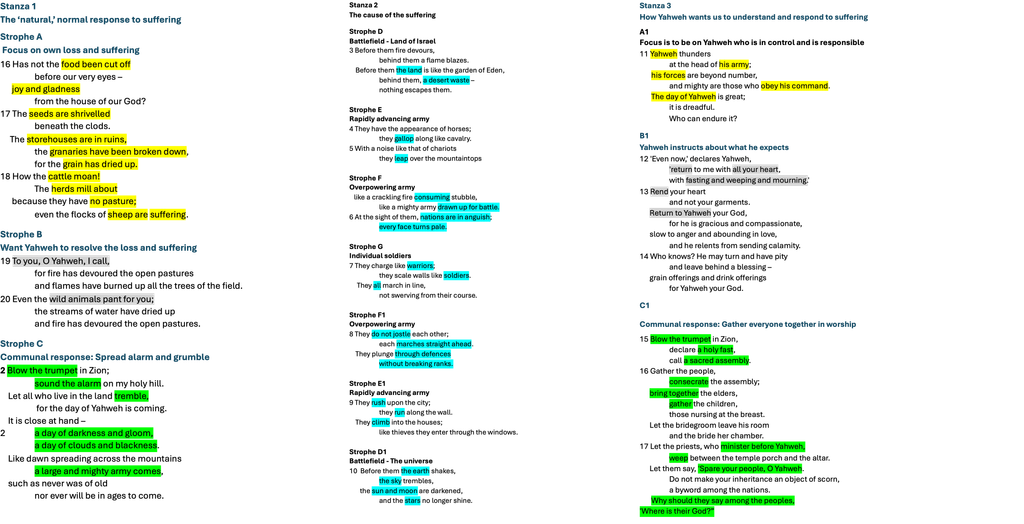
Stanza 1 Joel 1:16-2:2
The ‘natural,’ normal response to suffering
3. These first three strophes, A, B and C, are primarily about the natural reaction to trauma for the focus is looking backward at the crisis, the loss that has occurred and the suffering and trauma that is experienced and is expected to continue and get even worse. From the people’s perspective there is no hope, only despair and a fearful prospect of devastation and death lie ahead.
| Strophe A Focus on own loss and suffering 16 Has not the food been cut off before our very eyes – joy and gladness from the house of our God? 17 The seeds are shrivelled beneath the clods. The storehouses are in ruins, the granaries have been broken down, for the grain has dried up. 18 How the cattle moan! The herds mill about because they have no pasture; even the flocks of sheep are suffering. |
4. The psalmist complains on behalf of the people for he introduces strophe A with, ‘before our very eyes,’ as he relates the effects of the invasion. All vegetation has been destroyed so there is no ‘food’ available. And that affects their spiritual wellbeing so the ‘joy and gladness’ related to their worship of Yahweh has gone too.
5. The Hebrew translated as, ‘The seeds are shrivelled beneath the clods,’ is unclear but seems to have the sense of, ‘The seeds die in the dry earth’ (GNB) so may be referring to early spring when the new season’s seedlings would begin to appear.
6. The ‘storehouses … in ruins’ and ‘granaries … broken down’ seem to refer to the dilapidation of the storage facilities because there is no grain, or other crops, to be stored.
7. These two metaphors cover the growing season from the beginning to after the harvest so grain reserves would not be replenished and growing crops for at least a whole season would be impossible. That implies that this plague must have lasted many months so widespread starvation and famine leading to death for both humans and animals would result.
8. This description that focuses entirely on their personal material loss is highlighted by the animals that also complain – ‘the cattle moan!’ That word ‘moan’ seems to have the sense of ‘groan’ or ‘grieve’ and the translators’ inclusion of the exclamation mark seems to imply an anthropomorphic use so even the cattle complain. Their ‘pasture’ has been destroyed so they ‘mill about’ – wander in confusion – and ‘suffer’; that would be from hunger, the confusing noise, darkness and disruption of normality.
9. There is nothing wrong about this response to suffering. It is a normal, human reaction in such circumstances. But it is only one aspect of what is happening. It is, or ought to be, a phase that lasts a limited time only, in Yahweh’s plan for us as we deal with suffering and grief.
| Strophe B Complains to Yahweh 19 To you, O Yahweh, I call, for fire has devoured the open pastures and flames have burned up all the trees of the field. 20 Even the wild animals pant for you; the streams of water have dried up and fire has devoured the open pastures. |
10. Strophe B is more personal as Joel uses the singular to address Yahweh, complaining about metaphorical ‘fire’ and ‘flames’ that aptly describe the variegated colours and movement of the locusts as they destroyed the fields, ‘pastures,’ and woods, ‘trees of the field.’
11. I have not read of dried-up streams being a feature of locust invasions. I imagine that locusts would acquire sufficient fluid intake in the vegetation they consumed so the cause could be due to the loss of shade that would increase the evaporation rate in the hot and dry climate of the region or possibly a coincidental drought.
12. But notice that though he ‘calls’ out to Yahweh he does not ask for help, attention or anything at all. All he does is grumble, complaining about his loss in emotively expressive phrases that are developed further in strophe C. This is absolutely true to life, and is a poetic reflection on what is described as Village 1 in the Journey of Grief.
| Strophe C Spread alarm and grumble 1 Blow the trumpet in Zion; sound the alarm on my holy hill. Let all who live in the land tremble, for the day of Yahweh is coming. It is close at hand – 2 a day of darkness and gloom, a day of clouds and blackness. Like dawn spreading across the mountains a large and mighty army comes, such as never was of old nor ever will be in ages to come. |
13. In strophe C Joel has Yahweh speaking, as ‘my holy hill,’ is a Yahweh-phrase that is used 5 times in OT. In the next line it could appear that Joel is again the speaker, so I initially thought that this phrase was a poetic device to remind readers that this is a message from Yahweh.
14. However, the reference to ‘dawn’ that we will come to shortly is a Yahweh-revelation that therefore suggests that all this strophe is a message from Yahweh. But that does not imply that Yahweh approves their response. Rather, the grumbling, fearfulness and focus on their tragic experiences is a comment about what happens naturally. It is not a reaction that Yahweh would instigate. Yahweh wants his people then and now, to live by faith in him: recognising the danger and trouble, yes, but still being aware of Yahweh’s continuing presence and care. They were not to unduly focus on their troubles.
15. For Yahweh is in control! Their suffering is seen as an indication that, ‘the day of Yahweh is coming.’ This phrase occurs 25 times in Scripture and refers primarily to Yahweh’s judgement on those who have rebelled against him. Not all the references are about the final judgement. Some seem to refer to an immediate and local situation. The point, though, is that Yahweh is in control.
16. However, in all five NT occurrences there is hope for those who have turned to Yahweh in repentance and have lived in a God-honouring way. Furthermore, the NT references to ‘the day of Yahweh’ seem to blend into references to ‘the day of our Lord Jesus Christ’ so that is perhaps why they feature hope of deliverance from judgement. In the light of that, further reflection on the OT references and relating them more closely to their context reveals there is a clear hope of deliverance in at least three (Ezekiel 13:5, Joel 2:11 and Zephaniah 2:3). We will reflect on Joel’s reference in due course.
17. Not surprisingly, they are called to ‘tremble’ at the frightening prospect of the imminent, ‘day of darkness and gloom, a day of clouds and blackness’ as ‘a large and mighty army comes,’ so with that prospect a negative and fearful attitude seems entirely appropriate.
18. However, this fearful and negative reaction cannot, in any way, be a Yahweh-inspired approach. Yahweh calls his people, both then and now, to trust him, to live by faith. The OT is replete with stories of those who did that and there is a beautiful, stunning and challenging summary of their lives in Hebrews 11.
19. Then amidst the darkness, fear and horror, Yahweh’s speech contains that brief half-line, ‘like dawn spreading across the mountains,’ that changes the situation completely. It is easy to miss – and that is so true to life, for Yahweh is at work even in the depth of our traumas and suffering, shining his light. However, we can be so focused on our suffering that we miss the hints, and even the loud shouts, that show that Yahweh is involved in our lives however lonely and bereft we may feel. But, however could ‘a large and mighty army’ be appear ‘like dawn spreading across the mountain’? It seems contradictory.
20. Most of the 33 references to dawn in Scripture refer to the physical sunrise but here are those that refer to dawn metaphorically as this text does:
Commit your way to Yahweh; trust in him and he will do this: He will make your righteousness shine like the dawn, the justice of your cause like the noonday sun (Psalm 37:5-6).
The path of the righteous is like the first gleam of dawn, shining ever brighter till the full light of day (Proverbs 4:18).
See, darkness covers the earth and thick darkness is over the peoples, but Yahweh rises upon you and his glory appears over you. Nations will come to your light, and kings to the brightness of your dawn (Isaiah 60:2-3).
For Zion’s sake I will not keep silent, for Jerusalem’s sake I will not remain quiet, till her righteousness shines out like the dawn, her salvation like a blazing torch (Isaiah 62:1).
21. These metaphors use ‘dawn’ imagery to express ideas of relief from darkness, despair and trouble as the sun rises so there is both spiritual as well as physical light, that suggests a resurgence of hope and expectation of recovery, healing and blessing. Could that also be true of this phrase in Joel?
22. The difference that makes this imagery entirely appropriate is because Yahweh is involved. It is his army that is approaching. All that is happening is under his control and Yahweh has promised never to leave his people. So this phrase is, in reality, a beautiful, skilful and poetically apt way to end this section of the Joel’s Message with its despair and hopelessness, as the people struggle to cope with their calamities on their own. However, before we turn to the third section which relates to the same situation but where Yahweh is allowed to play the role he longs to fulfil, we need to reflect on Stanza 2 that describes their suffering metaphorically.
23. Stanza 2 is divided into seven strophes that are arranged chiastically
Stanza 2 Joel 1:3-10
The cause of the suffering – a devastating catastrophe
24. Here is a poetic description of the invasion that is arranged in paired 2-line strophes, D-D1, E-E1, F-F1 with a single strophe G in the centre. Often in such chiasmas, the key point, the ‘punch line’ is the central strophe but that does not appear to be the case here. I think the reason is that this stanza is only descriptive and is not a teaching strophe. Hence, I use ‘G’ rather than ‘X’ to convey this understanding.
| Strophe D Battlefield – Land of Israel 3 Before them fire devours, behind them a flame blazes. Before them the land is like the garden of Eden, behind them, a desert waste – nothing escapes them. | Strophe D1 Battlefield – the universe 10 Before them the earth shakes, the sky trembles, the sun and moon are darkened, and the stars no longer shine |
25. Strophe D refers to the land of Israel, a ‘garden of Eden’ that was a ‘land flowing with milk and honey’ (for example, see Deuteronomy 27:3) that became a ‘desert waste’ because of the locust plague that was as destructive as a ‘fire.’ Though that was only temporary in the long-term context of history, at the time it would have felt like a cataclysmic end with only destitution, starvation and death in prospect.
26. That is paired with strophe D1 that refers to the seemingly universal impact of the locust invasion, for the earth appears to ‘shake’ by the movement of millions of locusts that also ‘darken’ the sky, so the sun, moon and stars are obscured.
| Strophe E Rapidly advancing army 4 They have the appearance of horses; they gallop along like cavalry. 5 With a noise like that of chariots they leap over the mountaintops, | Strophe E1 Rapidly advancing army 9 They rush upon the city; they run along the wall. They climb into the houses; like thieves they enter through the windows. |
27. The approaching locust horde advances rapidly in strophe E giving the impression of an approaching army of horsemen that are ‘noisy’ (due to the sound of the beating of millions of wings) and just as horses can ‘leap’ over hedges and other obstacles even ‘mountaintops’ are trivial obstacles to this army. Sure, the imagery breaks down as it would be impossible for chariots to overcome such obstacles and in a real locust invasion, high mountains are one of the recognised barriers to the spread of locust plagues. But that is the point of using hyperbole, as such exaggeration is not describing facts but the impression that is created in the minds of those involved in such experiences.
28. This is parallelled in strophe E1 where the army, having flew (metaphorically speaking) through the countryside has now reached the city where they continue their rapid advance as they ‘rush, run and climb’ even into individual houses. The invasion is thorough, overwhelming and personal.
| Strophe F Overpowering army like a crackling fire consuming stubble, like a mighty army drawn up for battle. 6 At the sight of them, nations are in anguish every face turns pale. | Strophe F1 Overpowering army 8 They do not jostle each other; each marches straight ahead. They plunge through defences without breaking ranks. |
29. Strophe F describes the invaders as overpowering and all-consuming as the post-harvest ‘burning of stubble’ that is a quick way of preparing the ground for tilling that has and is used throughout the world, though it has some drawbacks so is no longer used in some countries.[1]
30. This imagery is extended in strophe F1 as the army acts as a unit going through whatever ‘defences’ are set up, without any hesitation.
| Strophe G Individual soldiers 7 They charge like warriors; they scale walls like soldiers. They all march in line, not swerving from their course. |
31. Strophe G concludes this description of the invaders by referring to the individual ‘soldiers’ who are committed, skilled and determined.
32. This imagery of the locust invasion sets the scene for the rest of Joel’s Messages. It is not a ‘scientific’ description but is phenomenological,[2] describing it as it appears to those involved and it uses figures of speech[3] such as metaphors and hyperbole that enable Joel to provide insights into the effects the invasion had on those who were experiencing it.
33. The impression this description has on us who read or hear Joel’s Message, is an aspect of poetry so it is important to pause and reflect on the impact it has as individuals and worshipping communities. Sense the overpowering awesomeness of the invasion that overwhelms the senses – the sight, hearing and even smell.
34. This description follows Stanza 1 that is about the ‘natural,’ normal and entirely understandable reaction to such a fear-inducing prospect. This reflection and review of the bad things that have happened is a defining feature of the first stage of grief. Those who suffer loss cannot move on. They must go through this first stage of grief. They must not try to, ‘pull yourself together, forget it and move on, look on the bright side or even tell God about it and hand over your troubles to him,’ as well-wishers may suggest.[4]
35. But Joel has something to teach Yahweh’s people for in their focus on their disastrous situation they seem to have lost touch with the reality that Yahweh’s people are not alone. Yahweh, the God who created them, who called and anointed them as his people is standing by to help, encourage and rescue. And that is what we come to in Stanza 3.
Stanza 3 Joel 2:11-17
How Yahweh wants us to understand suffering and respond to it
| Strophe A1. Yahweh is in control and is responsible 11 Yahweh thunders at the head of his army; his forces are beyond number, and mighty are those who obey his command The day of Yahweh is great; it is dreadful. Who can endure it? |
36. I was flummoxed when I started this study of Joel as I was expecting the invading army to be the ‘enemy’ of the nation and hence, of Yahweh so I had to read through all three chapters a number of times before I could accept that the invading army, whether locust or human, was Yahweh’s army and he was concerned not only to deal with the opposing ‘enemy’ but also to deal with his own people who had been distracted from their calling to live in dependence on Yahweh and were focussing on their troubles and fearful prospects.
37. So, when we apply this teaching to our own experiences of suffering and trauma, we face the fact that Yahweh is ultimately in control of whatever it is that is causing our distress. This does not have anything to do with the traditional ‘folk religion’ beliefs about battles between the goodies and the baddies, angels and demons, God’s people and Satanic forces. The army is Yahweh’s army. This concept may be hard to accept because there is a movement in ‘churchianity’ to regard all bad things that happen as part of the devil’s role, but the Bible is clear and blunt. Yahweh is in control. He sends these times of suffering.
38. In the earlier stages of this study my notes were littered with references to the ‘enemy.’ But ‘enemy’ is not used anywhere in Joel’s text and on reflection it is not implied either. I have now deleted ’enemy’ from my notes except for these four notes, 38-44, and two references in the Introduction that are about my initial impressions.
| Strophe B1 Yahweh instructs about what he expects 12 ‘Even now,’ declares Yahweh, ‘return to me with all your heart, with fasting and weeping and mourning.’ 13 Rend your heart and not your garments. Return to Yahweh your God, for he is gracious and compassionate, slow to anger and abounding in love, and he relents from sending calamity. 14 Who knows? He may turn and have pity and leave behind a blessing – grain offerings and drink offerings for Yahweh your God. |
39. So, in strophe B1 Yahweh instructs the people about his expectations. He wants more from his people than a ‘call’ as in strophe B. They are to come, ‘with all your heart, with fasting and weeping and mourning.’ Yahweh wants passion and commitment in our grief. This is not about ignoring our loss and moving on. Instead, Yahweh calls us to acknowledge the severity of our loss and then to passionately and devotedly bring our damaged hearts and troubled minds to our God who is Yahweh, the ‘Always I am’, the one who is always present and always able.
40. Rending garments, fasting, weeping and any other outward expression of our grief and loss are not sufficient in themselves. They are meaningless unless they express deep, heartfelt commitment – ‘rend your heart’ – as we turn in faith and obedience to Yahweh.
41. Joel reassures us that we will not be disappointed for Yahweh is, ‘gracious and compassionate, slow to anger and abounding in love.’
42. There is a hope that ‘he may turn and have pity and leave behind a blessing’ – but that is not an assured promise. We cannot bargain with Yahweh. We cannot earn his pleasure or expect a reward for good behaviour.
43. Do you see how close this is to the way the gospel message is presented? To have our sins forgiven and to be assured of eternal salvation we must trust in Jesus, God’s Son, God’s way of salvation. So now we see how that salvation continues throughout our lived experience as believers.[5] We must live by faith in Yahweh, continuing to trust, just as when we were first saved and came into God’s family.
| Strophe C1 Communal response: Gather everyone together in worship 15 Blow the trumpet in Zion, declare a holy fast, call a sacred assembly. 16 Gather the people, consecrate the assembly; bring together the elders, gather the children, those nursing at the breast. Let the bridegroom leave his room and the bride her chamber. 17 Let the priests, who minister before Yahweh, weep between the temple porch and the altar. |
44. And then in strophe C1 there is a call, not to grumble as in strophe C, but to gather together as Yahweh’s people.
45. However, rather than say ‘everyone is to gather’ Joel focuses on specific community groups as representatives of the whole. This is not an exclusive gathering. The elders, with their wisdom and experience yet with possible physical frailty, are included. So also are children, unable to contribute but they are the future and need to learn some important lessons and develop helpful habits. Breast feeding mothers, that naturally would include all with maternal responsibilities, are not to be neglected and sidelined as commonly happens in many communities. This gathering is so important that even newlywed couples, who were relieved of some social responsibilities (Deuteronomy 24:5), needed to be included.
46. They were to worship. The call is to a holy fast – a personal commitment – and to a ‘sacred assembly.’ Admittedly, there is no mention of the word ‘worship’ but we have had ‘sacred assembly’ then it is to be ‘consecrated.’ It is led by priests who ‘minister before Yahweh’ so in the absence of material for sacrifices (see Message 1, Strophe C1), prayers, Scripture reading and singing hymns would feature. That means worship!
47. Can you imagine how Joel’s Messages would have had a role in such gatherings? Surely, these gatherings would be an ideal opportunity for Joel’s Messages to be preached about and discussed in all the local communities throughout the nation. Bear this suggestion in mind as we continue our exploration of the Book of Joel.
48. The priests were to take their established role in leading the worship. They were to plead with Yahweh to ‘spare your people’ of their sufferings but this was not primarily for their sake. Rather, it was to ensure Yahweh’s name and reputation were not maligned or disrespected by other nations.
49. The priests were called to, ‘weep between the temple porch and the altar’ so that means they were in the Temple in Jerusalem. I find that curious as, so far, I have assumed that all the ‘action’ was taking place in people’s homes and local communities as that was where their crops and animals were and surely, the people would all still be there to protect their property while under such threats.
50. I do not see any reason to change that opinion, so it seems that the priests who were on the duty rota at the time, were there alone, and were even without the wherewithal of making offerings according to Message 1, strophe C1. Nevertheless, they were to continue as best they could, the daily worship rituals that were included in their calling to ‘minister before Yahweh.’
51. I think the point being made here is that when normal life is falling apart even to the extent of destitution and famine our communal responsibilities toward Yahweh still should be prioritised.
52. What a dramatic change in behaviour compared to Stanza 1! The focus is no longer on their loss and suffering as in Strophe A, nor is it about the awesome power of the opposing forces in Stanza 2. Instead, the focus is on Yahweh.
53. It is as true today as it was then that Yahweh’s people can be an ‘object of scorn,’ and a ‘byword’ meaning a typical example of the sort of behaviour that is widely regarded as worthy of contempt and mockery as worthless, inferior and unacceptable.
54. We can feel hurt and be distressed by that, but this is missing the point that Joel gets, for the ‘nations’ behave like this because they question, ‘Where is their God?’
55. It is this dishonouring the name of Yahweh and bringing it into disrepute that causes Joel’s distress.
56. Notice the parallels between this Strophe and Message 1, Strophe C1 for both are focussed on Yahweh, first in lamenting and now in reflection and appreciation – all features of worship.
57. Once we hear and take to heart Joel’s Message 2, we have turned our attention away from our troubles to Yahweh so we then, and only then, will be open to Yahweh’s instructions that we will come to in Message 3.
Main teaching points
58. All this is an amazingly insightful and spiritually focussed Message that fits in with the overall teaching of the Bible about trauma healing. Joel’s Message speaks powerfully into our experiences of trauma, damaged hopes and troubled minds.
59. The key Messages are:
a. Yahweh is with his people whatever goes wrong in our lives and communities. He never leaves, never forsakes.
b. The natural response to trauma is to focus on our loss and become despondent. We all do that – we cannot help it – but as people who are called to live by faith in Yahweh, more is expected.
c. We need to recognise that Yahweh is in ultimate control and that we grow in spiritual stature when we go through trials and suffering, provided we approach them in godly ways.
d. We must bring our grief to Yahweh, preferably in fellowship with those who are suffering similarly or at least are caring for us.
e. Lament, fast and persevere. Do we need to recover these ancient spiritual practices?
f. We must move along the Journey of Grief to a place where we turn our attention away from our suffering and the troubles that oppress us to recognise Yahweh’s presence, preservation and guidance. Then we can join Joel in seeking Yahweh’s honour and glory
60. Remember that in the Introduction we took 15 minutes or so to read the whole of the Book of Joel but now, when we analyse each individual Message, much more time is needed as we reflect and absorb these Messages.
61. And have you noticed that you have been repeatedly distracted from Joel’s Message by your personal memories of incidents in your own life that resonate with Joel’s Mssages?
62. Please do not rush on. Give yourself time to reflect on your own story. Bring your memories to Yahweh. Write about them. Draw pictures that reflect something of what happened.
63. Worship Yahweh as Joel encourages in any personal grief that is stimulated.
64. Can this be a communal exercise as in Joel’s time?
Endnotes
[1] Anon, Stubble burning, <https://en.wikipedia.org/wiki/Stubble_burning#:~:text=Stubble%20burning%20is%20the%20practice,to%20individuals%20across%20all%20ages> [accessed 16Mar25].
[2] ‘Phenomenological’ describes life as it appears to be. It is not an explanation but an interpretation. It is widely used in everyday conversation. For example, ‘sunrise’ is a phenomenological term as the sun only appears to rise – the word describes what we see. In scientific terms it is the earth and not the sun that is moving.
[3] Figure of speech, especially metaphors, are an important aspect of Hebrew poetry. See Frank Cole, ‘Windows 3 – Metaphors’ in https://psalm-insights.co.uk/introduction-to-psalm-insights/ [accessed 16 June 2026] for a brief introduction.
[4] For an introduction to the Journey of Grief, see, Frank Cole, The Journey of Grief toward Recovery and Healing, in <https://psalm-insights.co.uk/the-journey-of-grief-toward-recovery-and-healing/> [accessed 18 March 2026]
[5] This is not just a ‘Joel’ concept for it continues in the NT where 24% of ‘salvation’ words refer to the ongoing experience of salvation in various aspects of the Christian life. For further insights see, Frank Cole, ‘Theology of Trauma Healing,’ in, https://psalm-insights.co.uk/theology-of-trauma-healing/ [accessed 14 August 2026].
Written: 10 March 2025
Published: 15 October 2026
Click on the link to go to Message 3