Your word is a lamp to my feet and a light for my path. (Psalm 119:105)
Introduction
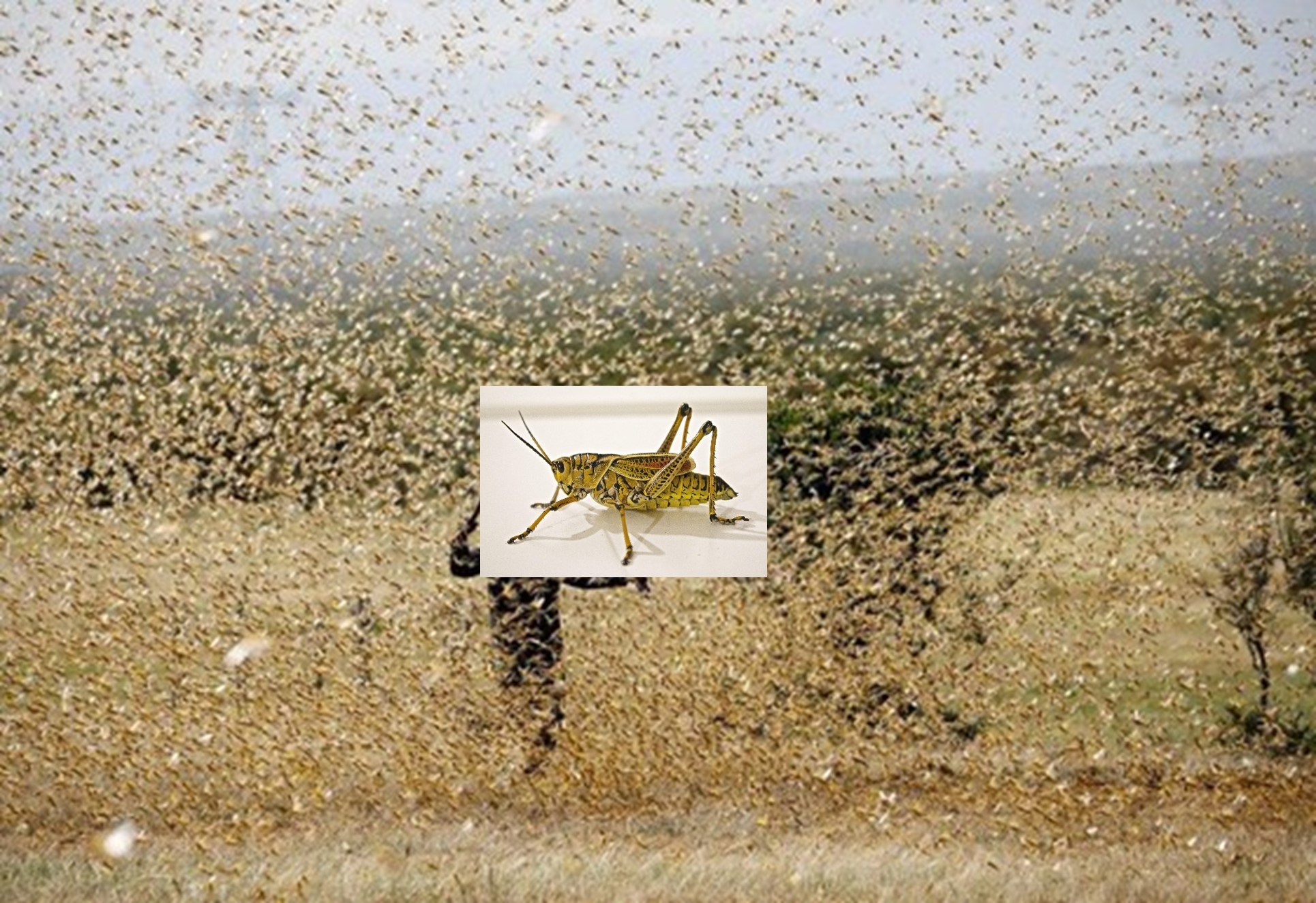
1. Joel introduces his book with a description of a locust invasion and the trauma and suffering it caused. He laments about a national catastrophe but there are hints also, that this is to be taken as a metaphor that anticipates the trauma and suffering Yahweh’s people were going to experience from an invading army (6). It naturally, therefore, speaks into our lives when we go through devastating experiences whether they are communal or personal.
2. You will notice that I refer to God as Yahweh. This is the name of the God of the Bible and is the commonest way our God is addressed in the Old Testament though invariably in English Bibles it is translated as ‘The LORD’. Yahweh means something like, ‘Always I Am.’ That is a powerful, emotive name that is loaded with rich spiritual meaning, so I am moving toward recovering its use.
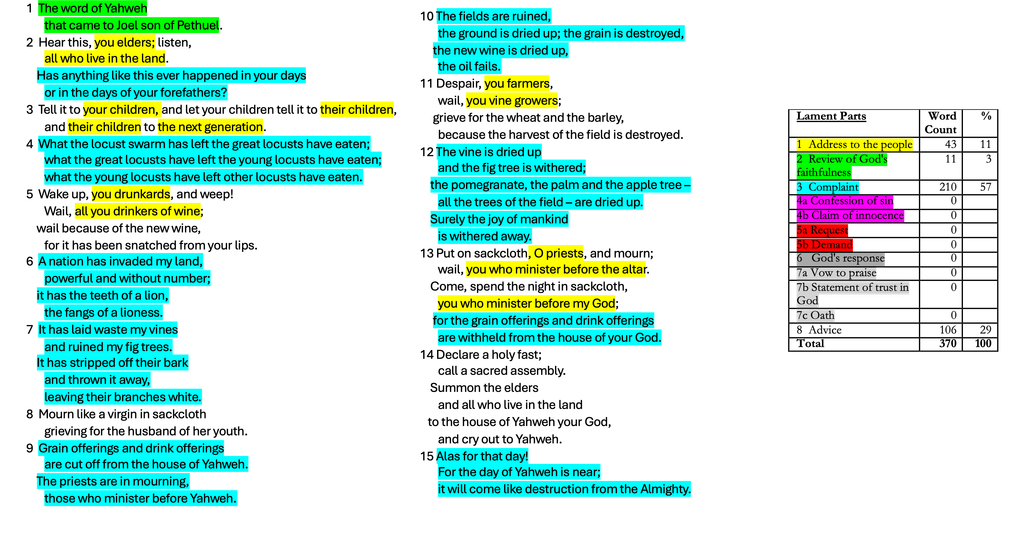
3. Joel’s first message is in the form a lament. These feature large in the Psalms – about half are classified as such and they have a distinctive poetic pattern and style. Most are addressed to Yahweh and express their feelings as the author and his companions go through intense experiences of suffering. Joel, however, does not address his lament to Yahweh. Instead, he speaks to the nation, complaining about their troubles, and does not include some common features of the psalm laments. Instead, and unlike all but Psalm 4 of the psalms I have studied so far, his lament has a major advisory and teaching role, helping the people to see their suffering as an aspect of Yahweh’s work in their lives, providing advice and guidance about how they should respond and giving hope about their future.
Lament structure
4. Lamenting is a feature of many ethnic communities and seems to have been the main form of poetry in ancient civilisations. However, it doesn’t feature much in modern western societies so we have extra lessons to learn to enable us to appreciate Joel’s teaching.
5. The book of Joel makes most sense if we see the locust invasion as something that has happened and the army invasion as something that is threatened. This lends itself to speaking into situations where whole nations or communities have experienced or anticipate going through some form of cataclysmic devastation. The Covid pandemic comes to mind and now the aggressive conflicts in Europe, Africa, the Middle East and the Far East introduce frightening prospects for many areas of the world.
6. However, its counsel will speak into any situation of trauma whether personal, familial or within a local community, let alone the national or international catastrophes that are already a distressing reality for millions of God’s people.
7. So let us now turn to the text that is set out here in what appears to be the original poetic format that features parallels between the ideas expressed in each strophe. The key words are in bold. See Introduction to Hebrew Poetry for more information.
Poetic structure
Lamenting a National Catastrophe
Joel 1:1-15 – Message 1
| A | 1 The word of Yahweh that came to Joel son of Pethuel. | Yahweh speaks through his prophet informing his people about his perception of what the key issue of the day was about. |
| B | 2 Hear this, you elders; listen, all who live in the land. Has anything like this ever happened in your days or in the days of your forefathers? | |
| C | 3 Tell it to your children, and let your children tell it to their children, and their children to the next generation. 4 What the locust swarm has left the great locusts have eaten; what the great locusts have left the young locusts have eaten; what the young locusts have left other locusts have eaten. | Parents, the guardians of future generations, must ensure children grow up knowing this message. |
| D | 5 Wake up, you drunkards, and weep! Wail, all you drinkers of wine; wail because of the new wine, for it has been snatched from your lips. 6 A nation has invaded my land, powerful and without number; it has the teeth of a lion, the fangs of a lioness. 7 It has laid waste my vines and ruined my fig trees. It has stripped off their bark and thrown it away, leaving their branches white. | A call to those who are wrapped up in their own selfish and wasted lives. |
| X | 8 Mourn like a virgin in sackcloth grieving for the husband of her youth. 9 Grain offerings and drink offerings are cut off from the house of Yahweh. The priests are in mourning, those who minister before Yahweh. 10 The fields are ruined, the ground is dried up; the grain is destroyed, the new wine is dried up, the oil fails. | A young woman who loses her husband before they complete their marriage ceremony is used as an example of a tragic loss that affects the whole community and not just the ones most immediately affected. Everyone is called to follow that example in how they respond. |
| D1 | 11 Despair, you farmers, wail, you vine growers grieve for the wheat and the barley, because the harvest of the field is destroyed. 12 The vine is dried up and the fig tree is withered; the pomegranate, the palm and the apple tree – the trees of the field – are dried up. Surely the joy of mankind is withered away. | A call to the farmers and vine growers, the core workers and backbone of the economy and the army. |
| C1 | 13 Put on sackcloth, O priests, and mourn; wail, you who minister before the altar. Come, spend the night in sackcloth, you who minister before my God; for the grain offerings and drink offerings are withheld from the house of your God. 14 Declare a holy fast; call a sacred assembly. | Priests, the guardians of the faith must set an example and lead the people in worship and repentance. |
| B1 | Summon the elders and all who live in the land to the house of Yahweh your God, and cry out to Yahweh. | Yahweh calls both leaders and all the people to gather at his place of worship and cry out to him. |
| A1 | 15 Alas for that day! For the day of Yahweh is near; it will come like destruction from the Almighty. | Yahweh’s word about the current destruction is a forewarning of what is yet to come. It will not be pleasant, it will involve destruction, but Yahweh the Almighty is in charge. |
Study notes
The above layout of Message 1 is available as a stand alone document that I recommend you have alongside as you work through the following notes.
8. Joel’s first comment sets the scene for both the message itself and the series of four messages. These messages are introduced in strophe A as ‘the word of Yahweh.’ Yahweh speaks through his prophet Joel providing his people with his perception of the nation’s situation and what he wanted them to learn so they could survive the traumas of life and live in a Yahweh-honouring way.
9. The final Message ends with the declaration, ‘Yahweh dwells in Zion!’ (Joel 4:21). That will become more meaningful at the end of this study but for now it confirms that whatever happens or is threatened, Yahweh is in control and in, ‘dwells in Zion,’ he confirms he is not remote and uncaring but is at the heart of his people’s life, purpose and worship.
10. This first Message is arranged in a straightforward chiastic format, so strophe A is paired with strophe A1. That too refers to Yahweh and introduces the phrase, ‘the day of Yahweh.’ That occurs 4 times in Joel and 20 times throughout the OT. It refers to the occasion when Yahweh intervenes in human affairs. Usually, the emphasis is on the retributive punishment of evil, but it is also about rescuing Yahweh’s people and establishing God’s kingdom of righteousness, peace and restoration. In the NT this concept seems to blend into the teaching about the ’Day of Christ’ (Philippians 1:6 and 2:16)[1] but the emphasis then is less on the punishment of the wicked and more about the establishment of Jesus as ‘King of kings and Lord of lords.’[2] It is possible that all the references do not refer to a single ‘Day of Yahweh’: probably, a number of different occasions are so designated.
11. Joel states clearly that the ‘destruction’ they were experiencing was not an accident, a mistake or the work of evil but was ‘from the Almighty.’ This fits in with many other Scriptures that declare that bad things that happen to Yahweh’s people are in Yahweh’s control and at his commission. For example, see Deuteronomy 29:16-29.
12. Yahweh’s ‘word,’ his message, is addressed in strophe B to both local community leaders, ‘elders’ (so this does not seem to refer to political or national leaders)[3] and all the people. It highlights that what is happening is an unprecedented catastrophe, yet locust invasions were not uncommon, so this must have been a particularly severe one. However, when we look back to this introduction from the later Messages, we can see that even this early on, Yahweh’s Messages via Joel are about more than a locust plague. It is as if Yahweh is using this traumatic experience to prepare his people for even worse experiences ahead.
13. The matching strophe B1 is similarly addressed and calls everyone as a priority, to respond to the tragedy by approaching Yahweh, to ‘cry out,’ expressing their grief, shock and horror about what was happening.
14. They are all summoned ‘to the house of Yahweh’ that can refer to the national sanctuary in the tabernacle/Temple but throughout the OT there is an awareness that Yahweh can be approached at any time and in any place. See, for example, Psalm 9:9-10 and then Joel 2:32 that is repeated in Acts 2:21 and Romans 10:12-13. This phrase, therefore, can be assumed to be a metaphorical call to approach Yahweh in worship and prayer in whatever way is appropriate for each person in their own particular circumstances.
15. In our modern world we are now recovering this ancient, Yahweh inspired, wisdom that the first response to a tragedy is to grieve. Trying to ‘fix it,’ to ‘understand’ or to immediately move on is not wise. Read more about this in The Journey of Grief.
16. Sandwiched between these introductory strophes Joel addresses four key community groups: parents, drunkards, the national work force and priests. He has a message for each according to their status in the nation. Each message is accompanied by a statement or two about different aspects of the locust plague that relate to the specific community group mentioned.
17. Strophe C is addressed to parents as the guardians of future generations for they must ensure that children grow up knowing this message. This is a remarkably perceptive statement. It is about more than keeping a record of historical events. We now are aware how important it is for children to be informed about the reasons calamities occur. Children are unable to appreciate why the adults in their lives, and parents especially, are distressed, fearful, distracted and irritable in such circumstances, so they too will become distressed, fearful, distracted and irritable, mirroring their parents’ emotions and may express this, for example, in nightmares, bed-wetting, squabbling, lack of interest and attention in their studies or duties. Not explaining, so children are ‘protected,’ causes more harm than good, as without any given explanation children will create their own explanation. Often, they will blame themselves or individuals or groups they know of who are sidelined or ‘different’ from their sense of ‘normality.’ As a result, they may end up as adults with a deep and seemingly irrational sense of insecurity and a lack of self-worth and/or be significantly bigoted.[4] Neither they nor their parents may understand how they have developed into such damaged people.
18. Theological literature discusses the apparent three ‘types’ or life-stages in the ‘swarming, great’ and ‘young’ locusts but that misses the poetic role of this statement. These words may be intended only to parallel the community, guardian and generational aspects of human society.
19. Strophe C is paired with strophe C1 where the priests,the ‘guardians’ of the faith, are called to set an example and lead the people in mourning in culturally relevant ways. That meant wearing sackcloth and wailing both day and night without rest.[7] They also had to fast and call everyone to gather to join in their mourning. This was ‘holy,’ so that meant it was a priority – time, energy and attention were to be devoted to this spiritual activity.
20. Such behaviour may be denigrated in modern, western cultures where there is a general sense that when facing tragedies, grief should be kept private, especially by community leaders and men. This was illustrated in the Covid pandemic in 2020 when the public emphasis was on developing coping strategies. I do not recollect any public acknowledgement of the emotional impact the impending pandemic was causing nor do I recollect anything much happening in churches or in the Christian media.[8]
21. The locust link is less pronounced here but the brevity of the link focusses on a key aspect of the plague for in, ‘the grain offerings and drink offerings are withheld from the house of your God,’ we are reminded that our active relationship with Yahweh our God and Master is a priority and not an optional extra to fit into busy lives if and when it is convenient.
22. Grieving is an aspect of biblical worship, but as our faith is inevitably influenced by Western post-Christian philosophies and culture that may come to many as a surprise. Bear in mind that the Psalms, the Israelite worship manual, was referred to as ‘Tehillim,’ meaning ‘praises’ – and yet half of the psalms are laments that focus on grief and often have aggressive complaints to and about Yahweh.[9] There may well be something significant here about biblical expressions of faith and worship that the Western-based church needs to rediscover.
23. Strophe D addresses ‘drunkards,’ the bane of virtually all societies throughout history, with a call to them as people who were wrapped up in their own selfish and wasted lives to the detriment of their family and community. The loss of their drug of addiction due to the devastation of the vineyards is expressed poetically and aptly in, ‘it has been snatched from your lips.’ In the context of the locust plague these ‘drunkards’ represent all those who, without due cause, are a drain on society and do not contribute to its wellbeing and development. They are called to ‘wake up’ to the reality of their situation.
24. The reference to the work of the locusts’ ‘teeth’ and ‘fangs’ as metaphorical lions is equally applicable to the devastation that results from alcohol abuse and other forms of addiction. And ‘laid waste,’ ‘ruined,’ ‘stripped,’ and ‘thrown away’ are all apt descriptions to describe the devastation that alcohol abuse causes to the person involved and their family and community.
25. This use of metaphors is a powerful way to get our attention. They resonate with our own experiences of life so, almost without thinking, they trigger memories that also include their emotional impact.
26. Strophe D1, in contrast to strophe D, refers to the other extreme of society – the farmers and vine growers, the core workers and backbone of the local and national economy, who laboured unceasingly to ensure there was sufficient food for all. And in times of trouble, they would become the defensive army.
27. Their link to the locust plague refers not to the staple crops of grain and grapes but to the ‘luxury’ crops that bring ‘joy’ and do more than just satisfy hunger and provide nutrition. These include crops such as figs, pomegranates, dates (the commonest fruit of the palm in the Middle East[5]) and apples[6].
28. These four groups are mentioned not because they were special or exclusive but because they were representative of all the people. This plague affected everyone. No one escaped.
29. In the centre is strophe X that calls the nation through these representative groups to mourn. The imagery of a mourning virgin refers to a young woman in mid-teens (in her ‘youth’) who was committed to be married (this betrothal means far more commitment than the British ‘engagement’ tradition) but loses her husband during the period between the betrothal and the consummation of her marriage after the formal marriage ceremony. Such a tragic loss affects more than the bereaved virgin. The marriage of a young couple was at the heart of a community, key to family cohesion and the first step toward ensuring the continuation of a family over the generations.
30. The mourning virgin, therefore links all sections of society. The reference to the locust plague in this strophe mentions the loss of the three main crops, grain, wine and oil, which is a reminder that starvation and many deaths are inevitable. As much as that is an awful prospect, in the same breathe, the loss of the ability to perform the prescribed religious devotions, is mentioned first. Could that mean it was of greater importance? That is what is implied in its inclusion in the central strophe.
31. In modern Western societies with their extensive health care services dying is only common in advanced age but in ancient times and even well into the 20th Century family deaths throughout childhood were common. However, a young man who had survived childhood and was accepted as fit and well enough to marry and continue the family line would be most unlikely to die. That emphasises how significant was the shock and horror that would be caused to the local community when such an event occurred. It was shocking. It was disturbing. It was unfair. It was unnatural. But it happened. It must be lived through.
32. The reference to the locust plague once again refers to the damage done to their ability to worship Yahweh as he had directed. This was important to the people described for they were not backsliding and abandoning their faith like their rulers and the many (probably) who followed their lead (which is the focus of much of the narrative sections of the Old Testament in books such as 1 Samuel – 2 Chronicles). For them this was a catastrophe.
33. However, Yahweh was with his people in their grief and mourning. He understood their grief and sent Joel to teach them how to deal with their situation. In this first message he acknowledges their dire situation. All he asks of them is that they mourn.
Teaching points
34. In this message Yahweh teaches his people through his prophet Joel how they should respond to calamities. The key lessons are:
- They must take the calamity seriously.
- Their first responsibility is to grieve communally and bring their grief to Yahweh.
- All sectors of society must be involved, including children and those who normally are a drain on society and do not pull their weight.
35. This teaching lament is all about a natural, real and overwhelming disaster but its lessons apply to all traumatic experiences. These lessons apply primarily to our communal experiences of trauma but are undoubtedly relevant to our personal traumas too.
36. This is an important lesson to accept if we are going to deal with our personal traumas in a godly way. When our lives go wrong and stressful it is all too easy to feel that God has let us down or is punishing us. We forget or refuse to accept that Yahweh has said:
‘Keep your lives free from the love of money and be content with what you have, because God has said, “Never will I leave you; never will I forsake you.” (Hebrew 13:5 quoting Deuteronomy 31:6).
That has been Yahweh’s promise to his people throughout Scripture.
37. It is reinforced in NT, especially by Jesus, in texts such as:
I will ask the Father, and he will give you another advocate to help you and be with you forever – the Spirit of truth … he lives with you and will be in you. I will not leave you as orphans; I will come to you (John 14:15-17).
38. These promises relate to Yahweh’s name that means something like, ’Always I Am’: always present, always available, always able to understand and help. Yahweh is by far the commonest way God is addressed in OT so this meaning was innate to Joel and his people’s use of this word. For us, who meet this as a new concept, we need to keep reminding ourselves of its use.
39. We must learn to live in the light of this truth.
40. It is then we can begin to appreciate James’ instruction:
Consider it pure joy, my brothers, whenever you face trials of many kinds, because you know that the testing of your faith develops perseverance. Perseverance must finish its work so that you may be mature and complete, not lacking anything (James 1:2-3).
41. The source of that joy is NOT because of the trial. Rather, it is because of the presence of Yahweh who lives in us and around us. Yahweh’s presence becomes more vital and significant as amidst the trauma and troubles of life all other supports shrivel away and fail. It is the presence of Yahweh that stays and produces joy.
42. As Joel continues his teaching in the following three messages, we will discover that how the people responded to the locust plague is training, in Yahweh’s hands, for even worse troubles that are going to come.
43. Here is something to ponder as you reflect on these studies of Joel’s messages.
44. Indubitably Joel’s messages are intended in Yahweh’s hands so we can learn from them, know Yahweh better and become better able to cope with the vicissitudes of life in a godly manner. Joel’s messages were written FOR us but they were not written TO us. Rather, they were written to Yahweh’s people of the time some 2,500 years ago. This was the nation of Israel who were living in the land Yahweh had given them. So, how might Joel have communicated his messages to the people? Reflect on that and see where it leads!
45. Before moving on, pause and consider if you need to grieve. Have you been reminded of a loss that still troubles you? Recurrence of such a loss now, may be a nudge from your loving heavenly Father to revisit that loss and reflect on what it means to you. As you do so, it will be helpful to express your grief in writing or drawing about what happened, how you felt and what was the worst aspect of your loss. Do not rush. Take time to record your memories then take further time reflecting on them. Do you have a trusted friend with whom you can share something of your story? This is also helpful. But this is not for advice or counsel or even prayer (well, not for specially focussed prayer! The main purpose is so you can express yourself. You will be talking to yourself as well as your friend and this helps self-understanding. When you are ready prayerfully hand over your grief, pain and sadness to Jesus, for Jesus said, “Come to me, all you who are weary and burdened, and I will give you rest,’ (Matthew 11:28). Rest in his healing touch. This does not necessarily take away every memory but it does take the pain away. It may return, perhaps triggered by a different loss or a reminder about what happened. Jesus is still there with you! So, again, hand over whatever it is that troubles you, to Jesus.
Endnotes
[1] Related texts include: 1 Corinthians 1:8, 3:13, 5:5, 2 Corinthians 1:14, Philippians 1:10, 2 Timothy 1:18, 4:8.
[2] J. S. Wright, ‘The day of the Lord,’ in J. D. Douglas and others, (Ed.) The Illustrated Bible Dictionary, (Leicester: Inter-Varsity Press, 1980), p. 369.
[3] William D. Mounce, Mounce’s Complete Expository Dictionary of Old and New Testament Words, (Grand Rapids, MI: Zondervan, 2006), p. 208.
[4] Dana Ergenbright and others, Healing the Wounds of Trauma: How the Church Can Help – Stories from Africa, (Participant Book for Healing Groups), revised edn (Philadelphia, PA: SIL International and American Bible Society, 2021), is the Trauma Healing Institute handbook for trauma healing facilitators and has lesson 8, pp. 74-83, about helping children who have been traumatised. Jane Mitchell and Sarah Naish, The Complete Guide to Therapeutic Parenting, (London: Jessica Kingsley Publishers, 2021) describes a UK based, secular model for assessing and helping traumatised children.
[5] The Middle Eastern climate is too dry to support other palm trees such as the coconut or oil palm tree.
[6] Experts think this may be a generic term for fruit trees or refers to apricots. See Irvin A. Busenitz, Joel & Obadiah, A Mentor Commentary, (Fearn, Ross-shire: Christian Focus Publications, 2003) p.88.
[7] Nighttime worship may have been a normal feature of the Temple worship schedule according to Psalm 134:1 and 1 Chronicles 9:33.
[8] However, suitable materials were available as in an amazing coincidence ( a God-incidence), the Trauma Healing Institute published internationally in January 2020, just as the Covid pandemic was starting, their self-help materials ‘Beyond Disaster’ that were based on the facilitator workbook, ‘Healing the Wounds of Trauma: How the Church Can Help’ and within 3 months followed up with guidance notes for small groups for both adults and teenagers that dealt specifically with the emotional and spiritual impact of Covid. See <https://www.eauk.org/news-and-views/helping-people-heal-from-trauma-caused-by-coronavirus> for a brief overview.
[9] Gordon Wenham, The Psalter Reclaimed: Praying and Praising with the Psalms, (Wheaton, IL: Crossway, 2013), pp. 43-50.
Written: 24 February 2025
Published: 15 October 2026
Click on the link to continue to Message 2.