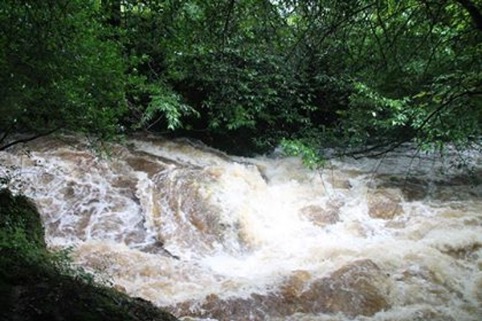
Your word is a lamp to my feet and a light for my path. (Psalm 119:105)
Psalm 42 (NIV, 1984)
For the director of music. A maskil of the Sons of Korah.
1  As the deer pants for streams of water,
 	so my soul pants for you, O God.
2  My soul thirsts for God, for the living God.
 	When can I go and meet with God?
3  My tears have been my food
 	day and night,
   while men say to me all day long,
 	Where is your God?"
4  These things I remember
 	as I pour out my soul:
   how I used to go with the multitude,
 	leading the procession to the house of God,
   with shouts of joy and thanksgiving
 	among the festive throng.

5  Why are you downcast, O my soul?
 	Why so disturbed within me?
   Put your hope in God,
 	for I will yet praise him,
 	my Saviour and 6 my God.

   My soul is downcast within me;
 	therefore I will remember you
   from the land of the Jordan,
 	the heights of Hermon – from Mount Mizar.
7  Deep calls to deep
 	in the roar of your waterfalls
   all your waves and breakers
 	have swept over me.

8  By day the LORD directs his love,
 	at night his song is with me –
 	a prayer to the God of my life.

9  I say to God my Rock,
 	"Why have you forgotten me?
   Why must I go about mourning,
 	oppressed by the enemy?"
10 My bones suffer mortal agony
 	as my foes taunt me,
   saying to me all day long,
 	"Where is your God?

11 Why are you downcast, O my soul?
 	Why so disturbed within me?
   Put your hope in God,
 	for I will yet praise him,
 	my Saviour and my God.
Notes
1. As usual, I have adapted the NIV 1984 version removing the paragraph spaces. Only once (verse 8) is God referred to as LORD, meaning Yahweh.
2. The fact that the medieval verse divisions are unhelpful in understanding Scripture is brought home here as verse 6 starts in the middle of a phrase. That is so confusing I have moved the figure to the beginning of the next line.
3. The ‘deer’ in verse 1 refers to the small fallow or roe deer that is 80-100cm tall at the shoulder and is found in the hill country where water was sparse. It is usually a solitary creature but may be in very small groups. Its dappled coat is good camouflage.[1]
4. Verse 6 is also curious as its two lines are in one sentence but the first line’s ‘downcast’ links to the same word in verse 5 and ‘Jordan’ refers to the river with its ‘waterfalls’ mentioned in verse 7. I have therefore chosen to alter the punctuation.
5. I do this cautiously though, as I have been unable to find a translation that does this. The test of its validity will come when we see how it affects the poetic structure.
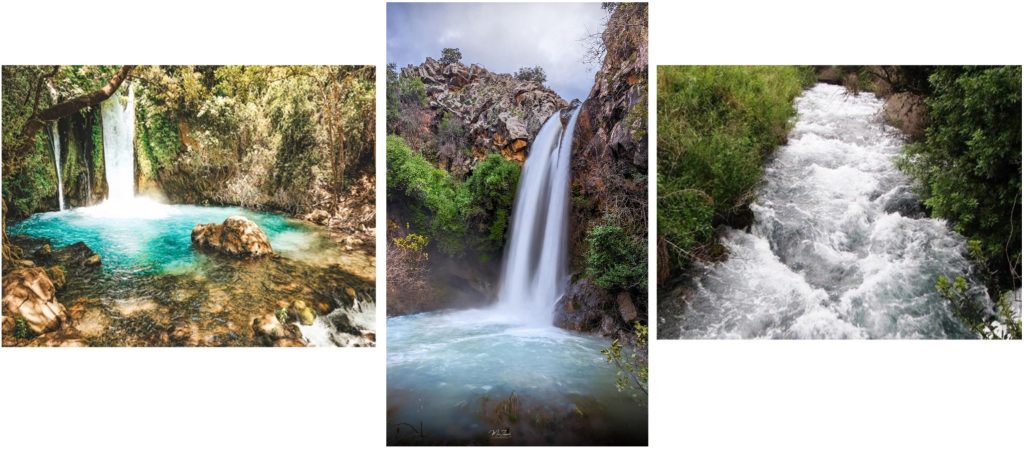
6. At first glance I thought that, ‘all your waves and breakers have swept over me,’ (verse 7) referred metaphorically to a storm in the Mediterranean Sea or Lake Galilee but the mention of ‘Jordan’ and ‘Hermon’ makes it clear that it refers to the upper reaches of the River Jordan that does have waterfalls.
7. River Jordan has three main tributaries, Rivers Dan, Banias and Hasbani, that all arise in the Mt. Hermon range in Lebanon. They merge in the Hula Valley, north of Lake Galilee. These are fast flowing streams each with a series of waterfalls in fertile countryside with a Mediterranean climate. This is dramatically different to the sluggish, meandering River Jordan as it approaches Galilee and then throughout its length to the Dead Sea where the climate is subtropical. It is a reasonable assumption that the psalmist is referring to these tributaries when he links ‘Jordan’ with ‘waterfalls.’
Psalm 42 – Adapted
1  As the deer pants for streams of water,
 	so my soul pants for you, O God.
2  My soul thirsts for God, for the living God.
 	When can I go and meet with God?
3  My tears have been my food
 	day and night,
    while men say to me all day long,
 	Where is your God?"
4  These things I remember
 	as I pour out my soul:
    how I used to go with the multitude,
 	leading the procession to the house of God,
    with shouts of joy and thanksgiving
 	among the festive throng.
5  Why are you downcast, O my soul?
 	Why so disturbed within me?
    Put your hope in God,
 	for I will yet praise him,
 	my Saviour and my God.
6  My soul is downcast within me;
 	therefore I will remember you.
    From the land of the Jordan,
 	the heights of Hermon – from Mount Mizar,
7  Deep calls to deep
 	in the roar of your waterfalls
    all your waves and breakers
 	have swept over me.
8  By day Yahweh directs his love,
 	at night his song is with me –
 	a prayer to the God of my life.
9  I say to God my Rock,
 	"Why have you forgotten me?
    Why must I go about mourning,
 	oppressed by the enemy?"
10 My bones suffer mortal agony
 	as my foes taunt me,
    saying to me all day long,
 	"Where is your God?
11 Why are you downcast, O my soul?
 	Why so disturbed within me?
    Put your hope in God,
 	for I will yet praise him,
 	my Saviour and my God.
8. Psalm 42 is recognised as a lament psalm so the following layout shows the different parts.
Psalm 42 – Lament structure
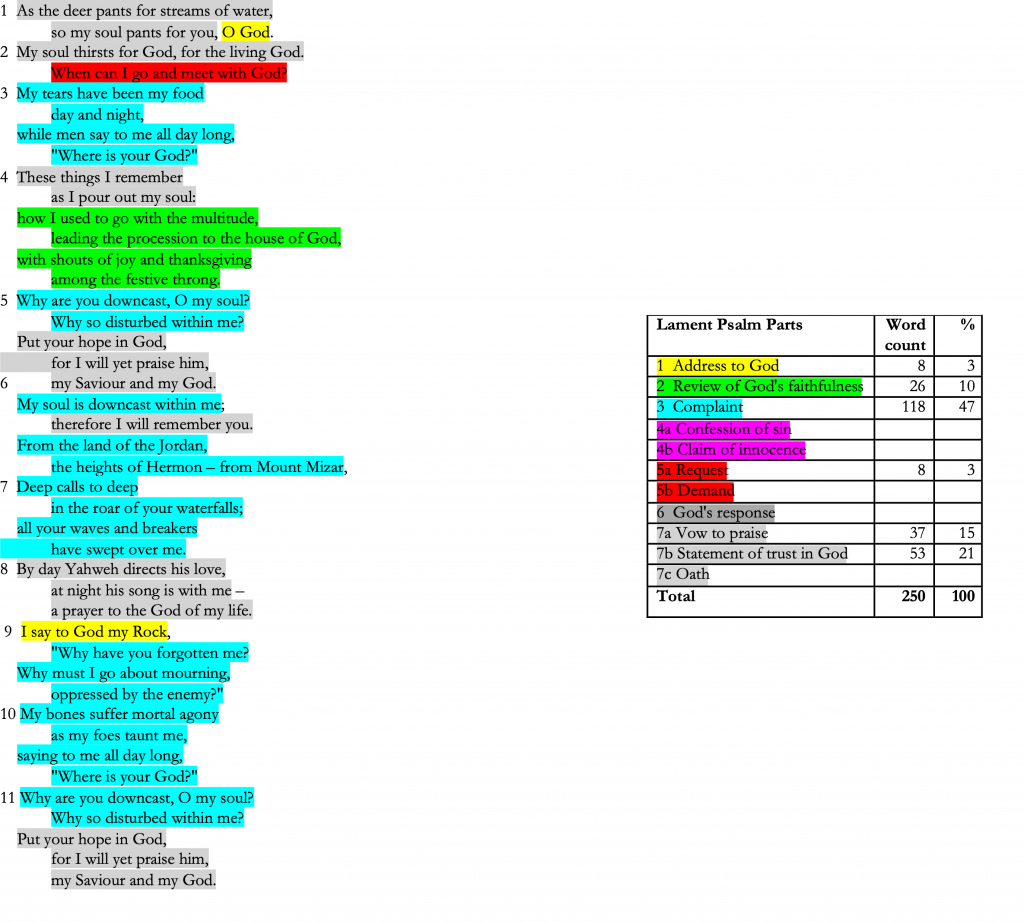
9. This lament includes all the main feature of a lament but it is gentle and reserved. Yahweh is not blamed for being absent even though the psalmist feels bereft. He is not happy or comfortable about his situation but seems to be willing to hang on, so he encourages himself in this lonely place in the expectation that his circumstances will improve.
10. Bible scholars comment about the similarities between Psalms 42 and 43 so some speculate that they were originally one psalm. I do not have the knowledge base to contribute to that discussion so will study them separately. Besides, unlike the numbering of chapter divisions in the rest of Scripture, the numbering of the Psalms is very ancient so there is every reason for accepting them as the psalmist’s intention. There has to be very good reasons for altering this.
11. The next task is to identify the strophes.
12. We look for the idea promoted in each line, see if this is in association with neighbouring lines, thus forming a strophe and then look for parallels with other strophes. All this helps to reveal the theme of the psalm.
13. In the following layout these ideas and parallels are colour coded.
Psalm 42 – showing strophes
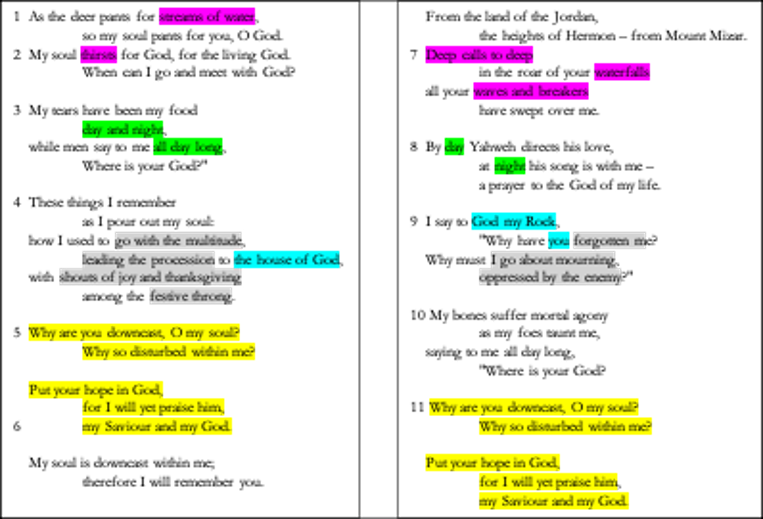
14. This suggests a possible layout as shown below. Stanzas 1 and 3 each have 4 paired strophes with the one-line stanza 2 in the centre of the psalm.
Psalm 42 (NIV)
Yahweh is available to help whatever trauma we experience
| Stanza 1 | The psalmist finds refreshment in Yahweh even when life does not go well | |
| Strophe A | 1 As the deer pants for streams of water, so my soul pants for you, O God. 2 My soul thirsts for God, for the living God. When can I go and meet with God? | Just as a wild deer in the hill country eagerly seeks water so the psalmist seeks God – but why does he delay? |
| Strophe B | 3 My tears have been my food day and night, while men say to me all day long, “Where is your God?” | He grieves unceasingly with no human comfort or understanding. |
| Strophe C | 4 These things I remember as I pour out my soul: how I used to go with the multitude, leading the procession to the house of God, with shouts of joy and thanksgiving among the festive throng. | Even as he expresses his grief he is encouraged as he recollects times of joyful worship with the crowds he led into God’s presence. |
| Strophe D | 5 Why are you downcast, O my soul? Why so disturbed within me? Put your hope in God, for I will yet praise him, my Saviour and my God. | He recognises that his current depressive anxiety is only temporary, so his hope rests in his Saviour God, not on his circumstances. |
| Stanza 2 | Whatever the cause of his distress the psalmist turns to Yahweh for help | |
| Strophe X | 6 My soul is downcast within me; therefore I will remember you. | The core message of this psalm is that even though the psalmist is overwhelmed by his depressive anxiety he chooses to focus his attention on Yahweh. |
| Stanza 3 | The psalmist acknowledges and accepts that Yahweh is behind the troubles of life | |
| Strophe A1 | From the land of the Jordan, the heights of Hermon – from Mount Mizar – 7 Deep calls to deep, in the roar of your waterfalls; all your waves and breakers have swept over me. | The God the psalmist seeks is also the God who is in ultimate control of the flood of troubles that overwhelm him. He feels as if he is being swept along by the raging torrents in the upper reaches of the River Jordan. |
| Strophe B1 | 8 By day Yahweh directs his love, at night his song is with me – a prayer to the God of my life. | Even in his continuing grief and awareness of Yahweh’s role in his suffering he acknowledges the care Yahweh, the ‘Ever I Am’ God, shows., That is the focus of his nightly worship that include singing and prayer. |
| Strophe C1 | 9 I say to God my Rock, “Why have you forgotten me? Why must I go about mourning, oppressed by the enemy?” 10 My bones suffer mortal agony as my foes taunt me, saying to me all day long, “Where is your God?” | Though he acknowledges God as his secure rock, he still feels alone as if God has forgotten him. He grieves openly (mourns) and that seems to stir his enemies to oppress and taunt him. His suffering is physical as well as emotional and seems to be life-threatening (mortal). |
| Strophe D1 | 11 Why are you downcast, O my soul? Why so disturbed within me? Put your hope in God, for I will yet praise him, my Saviour and my God. | However, he recognises that his current depressive anxiety is only temporary so his hope rests in his Saviour God, not on his circumstances. |
15. Changing the punctuation has been an essential step in revealing the above poetic structure. That confirms the validity of this change (see notes 4-5).
16. Psalm 42 seems to be independent to Psalm 43 but they are similar (see note 10). Psalm 42 is about turning to Yahweh whatever the nature of the experience of trauma. Psalm 43 is about a specific trauma in which the psalmist is falsely accused of wrongdoing.
17. It is therefore not unreasonable that one strophe, D that is duplicated in D1 in Psalm 42, is also used in Psalm 42 though in Psalm 42 it is divided between two strophes, B1 and A1.
18. This psalm is a lament that is spiritually mature. Though he is seriously distressed and suffering from some opposition that somehow precludes him from leading worship in the sanctuary, he does not rail against Yahweh for sending the troubles he is experiencing, nor for his seeming absence. And though downcast and possibly feeling mortally ill he still encourages himself to hope in God and look forward to when he will again feel free to worship.
19. I am leaving this study for now and will be pleased if someone analyses it in greater depth – or even finds a better way to understand the psalm in the context of its poetic structure. Please do share any such study on this website.
Footnotes
[1] G. S. Cansdale, ‘Animals,’ in J. D. Douglas and others, (Ed.) The Illustrated Bible Dictionary, (Leicester: Inter-Varsity Press, 1980), p.58.
Written: 21 September 2019
Published: 12 August 2026