
Your word is a lamp to my feet and a light for my path. (Psalm 119:105)
Introduction
1. This final Message puts the three previous Messages in perspective. The locust invasion does not get a mention! It is now clear that, though it was a real and devastating event, it featured as a lived-in metaphor about the trauma and suffering the people were going to endure, and learn how they could recover – the topic in Messages 2 and 3. The future that has been hinted at comes into perspective in Message 4 but, as we would expect, is presented in metaphors. This is not ‘special knowledge’ of future history but glimpses and hints that are intended to inspire and encourage us to live life now, living out our lives with our focus on Yahweh himself and not on his gifts or plans, our troubles or our own ideas or ambitions.
2. A progressive account unfolds in this final Message 4 as Joel turns from the troubles and tragedies of the people’s present experience to describe the future that will feature Yahweh’s control over all his people, both the nation of Israel and the rest of humanity, including those who have rebelled against his rule.
3. But notice that the opposition to Yahweh’s people changes from ‘the northern army’ (assumed to be Assyria) in Message 2, to Tyre, Sidon and Philistia in Message 3 and now Egypt and Edom in Message 4. I do not think we should make too much of this in trying to pin down Joel’s ministry to a particular period. Perhaps it suggests that Joel does not want his Message to be restricted to one era or episode.
4. His Messages are thereby intended to cover all such threats and actual invasions. That makes it easier to see how his Messages relates not only to national troubles and actual warfare. It equally relates to pandemics and economic calamities and, of course, to the personally significant losses and sufferings that we all experience at various times in our lives.
5. And now, in Message 4, having obtained our attention and given guidance about living a Yahweh-honouring life while living through horrendously stressful circumstances, Yahweh puts those experiences into an eternal perspective by revealing something of Yahweh’s plans for his people and his creation’s future.
6. This is not intended to provide ‘inside information’ to his favoured few. Rather, it is to reassure us that Yahweh is in control, his plans are for our good and the betterment of the damaged world in which we live. Our task is to live by faith in Yahweh, trusting him for the big plans Yahweh has for the world he created as well as for the intimate details of our personal lives and circumstances.
7. This is how Yahweh wants us to live our lives.
8. The poetic boundaries of Message 4 were set as it fills the gap between Message 3 and the end of the book; but initially, there appeared to be a jumble of scattered comments with no clear links between them.
9. I was so confused at one point that I explored the possibilities that there might be more than one Message or the division between Messages 3 and 4 was in a different place.
10. I was helped by going back to basics.
a. Look for patterns – especially between the ideas expressed in the Strophes, either individually or in small groups.
b. The pattern would be essentially simple for Yahweh wants us to understand his word and recognise that the poetic pattern is an aspect of Yahweh’s inspiration.
c. There could be new expressions of the way parallelism was used.
d. Underlying all such interpretations there has to be an awareness of the message that Yahweh is seeking to impart and an openness to relinquish preconceived ideas.
11. There were some oddities that could be clues. For example, Stanza 9, that is only a half-line, that ends Message 4 is unusual, for the only common use of half-lines found so far is in those Psalms where ‘Praise Yahweh’ features at the beginning and end (see Psalm 147, note 1 and Psalm 18).
12. Then Stanza 1, ‘Yahweh has spoken’ (such a brief phrase!) only becomes apparent when the prose section of Joel 3:4-8 (NIV) is converted to a poetic format (as described in Introduction notes 30-34). The pairing appears to be apt with Stanza 1 confirming that the book of Joel is Yahweh’s word to his people – ‘The word of Yahweh that came to Joel …’(Joel1:1) – and it neatly parallels Stanza 9 that succinctly confirms the core message of the book of Joel, and even of the whole of Scripture, that Yahweh is in control and is with his people. Could they mark the beginning and end of Message 4?
13. That alerted me to the possibility that there might be more isolated half-lines in the Message so, later, I identified what became Stanzas 3, 5 and 7.
14. Initially, I had assumed that what became Stanza 2 was addressed to Yahweh’s people, Israel, and those who threatened the nation were the ‘enemy’ of Israel (see Message 3, note 31 regarding the use of ‘enemy’). Surely, that therefore meant they were enemies of Yahweh too. That perspective appears in psalms such as Psalm 5 and Psalm 21 and fits the model of conflict between nations being matched by conflict in the spiritual realm between the gods of the individual nations. Though that model is in Scripture, it is not a model that expresses Yahweh’s plan but instead is an expression of a human attempt to understand how the world works.
15. But what if Yahweh regards these other nations as his people who are rebelling against his control? Perhaps Yahweh is not interested so much in their defeat and annihilation as he is in their repentance and reconciliation to himself, acknowledging his Lordship and right as Creator and Ultimate Authority. That is illustrated in Psalm 66.
16. Bearing these features in mind led to an understanding of the poetic structure. It is unusual but enhances the teaching of Joel’s fourth Message that is in keeping with Yahweh’s revelations about his plans and purposes in other parts of Scripture.
17. To portray the poetic structure, I have used the designatory numbers and letters in a different layout to other studies. Please note that the parallel Stanzas use the same poetic structure. However, though the internal parallels are strong, the links between the two Stanzas are not as well-developed as usual.
18. Message 4 has some elements of a chiastic structure but nevertheless there is a linear progression through the Message, telling a story about future events.
19. So, here is a colour-coded overview of the poetic structure of Message 4.
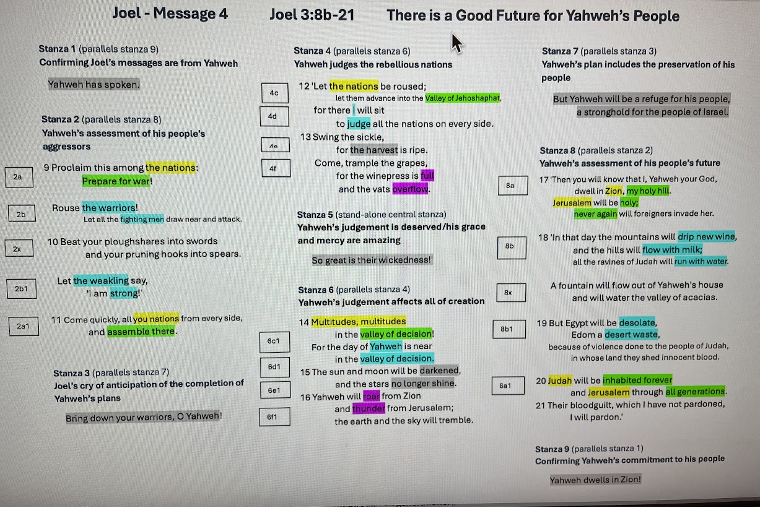
Analysis of poetic structure
Stanza 1
Confirming Joel’s Messages are from Yahweh
| 8b Yahweh has spoken. |
20. Stanza 1 confirms that the author has presented his Messages as Yahweh’s word to his people. All that has been said throughout the four Messages is Yahweh’s perspective on the troubles and trials of life but now in Message 4 these are seen in their eternal perspective.
Stanza 2
Yahweh’s assessment of his people’s aggressors
| 2a | 9 Proclaim this among the nations: Prepare for war! |
| 2b | Rouse the warriors! Let all the fighting men draw near and attack. |
| 2x | 10 Beat your ploughshares into swords and your pruning hooks into spears. |
| 2b1 | Let the weakling say, ‘I am strong!’ |
| 2a1 | 11 Come quickly, all you nations from every side, and assemble there. |
21. I approached Stanza 2 on the presumption it was about ‘weakling’ Israel who was challenged by Joel to be ‘warriors’ that required them to turn from their subsistence farming, refashion their farming tools into weapons and go into battle against overwhelming odds (‘the nations’ – note the plural). In doing so, however, they would be under the command of Yahweh (‘Bring down your warriors, O Yahweh’ in Stanza 3) that would be their secret strength and would bring confidence of victory. But why would this battle strategy be advertised to the opposing forces, ‘proclaim this among the nations,’ and why would the nations be called to ‘assemble’ – as if on parade? And as it turns out in Stanza 4, Yahweh’s intention is not to have a battle but to call the erring nations to account.
22. A counterintuitive interpretation fits much better poetically. It also demonstrates that Yahweh’s perspective is not to see the potential conflict as tribal warfare but as a calling to account of sinful, rebellious, citizens of Yahweh’s worldwide kingdom who must answer for their abominable behaviour, to Yahweh, the one and only God Almighty, who is the Creator and Ultimate Lord of all nations and people, the universe and beyond.
23. When faced by opposition that is strong and overpowering we question our own beliefs and attitude and the human reaction is to wonder about personal and cultural survival. But when we see such opposition from Yahweh’s perspective, there is no reason to be fearful or anxious. Yahweh is not concerned in the slightest about the enemy’s resources and plans, but he is concerned about their wickedness. Changing such a mind-set is difficult and counter-intuitive but is an essential aspect of living life on Yahweh’s terms.
24. This perspective enables Stanza 2 to be seen as a mocking call to puffed up, self-righteous rebels who were being called to account for their rebellious behaviour by Yahweh himself whose longsuffering patience had at last ran its course. It is tempting to immediately slip into a consideration of the final judgement for all nations at the end of time, but I doubt that was what Joel had in mind. I suspect he was expecting a localised and timely end to this rebellion that would establish Israel as the leading nation with Yahweh in obvious control and other nations taking a subservient role but still acknowledging Yahweh’s sovereignty.
25. So now we can see how Stanza 2 is intended to be understood.
26. Joel writes to his own people so, even though Stanza 2 proclaims a message to ‘the nations’ who were threatening to invade Israel his message was for Yahweh’s people, the threatened victims of this aggression. Its purpose is to inform Yahweh’s people – both in Joel’s generation and in our time – so they and us are aware of Yahweh’s assessment.
27. Stanza 2 has a chiastic structure that shows that the opposition, though numerous (the nations), is not actually as powerful as at first might appear in Strophes 2a and 2b. In the context of the political situation in Joel’s time, whenever that was, the nations referred to would be neighbouring nations that were threatening to overrun and subjugate Israel. This seems to refer to a greater conflict than can be imagined taking place with the local neighbouring nations that consisted of Edom to the south, Moab and Ammon to the east and Aram (Syria) and Phoenicia to the north.
28. The Philistines, who were a major threat when Saul and David ruled and were based on the Mediterranean coast to the west, seem to have had a lesser role and impact in later generations.
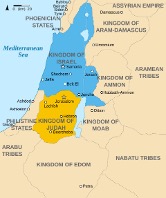
29. These small nations, with Israel, occupied the land corridor between Egypt in the south and Assyria in the north. That northern land in later centuries became Persia and then Greece, the Ottoman Empire and Turkey, so this land corridor was inevitably the battle ground for these superpowers whose rivalry and conflict continued intermittently for hundreds of years.
30. Joel calls on the warriors to prepare, Strophe 2b, but in Strophe 2x recognises that these were not the professional soldiers of Message 2 but farmers who would have to adapt their farming implements into weapons. And if they did that who would tend their crops? And even if some were left behind how could the work be done if there were no implements to use?
31. Going to war called for commitment, hard work and determination for the family and community if they were to survive the absence of the family heads and community leaders.
32. They would be taking on a big task so inevitably there would be personal danger of death or disability and if the harvest failed due to the absence of farmers, famine could result. So, the reference to ‘weakling’ in Strophe 2b1 that initially seems to refer to physical weakness could also include those who suffered ‘psychological’ weakness related to the fears they would experience.
33. This Stanza is rounded off in Strophe 2a1 with a call to the surrounding (‘from every side’) nations to ‘assemble there.’ That contrasts with ’prepare for war’ of Strophe 2a so is a hint that this is not, after all, about a battle.
34. Altogether, Stanza 2 is preparing the way for later revelations. Although addressed to the opposition this is a rhetorical device to impart some stunning information to Yahweh’s people: Yahweh wants them to know what he thinks of the opposition. Whereas Messages 2 and 3 give an impression of a powerful professional army here in Message 4 they are mocked as amateur and ill-equipped farmer/soldiers.
35. Will the people accept these Messages? Will they be willing to trust Yahweh rather than what they hear, see or fear? Joel leads the way and sets an example. He has so much confidence that he interjects a brief cry of anticipatory triumph in Stanza 3.
Stanza 3
Joel’s cry of anticipatory triumph
| Bring down your warriors, O Yahweh! |
36. Initially I thought that this was a cry of the reassured Israelites but latterly I have sensed that they did not yet have such assurance. But Joel did!
37. The brevity of his Stanza 3 cry – only half of a normal poetic line adds to its impact.
38. But notice that Joel refers to the opposition as ‘your warriors, O Yahweh.’ This is one reason why I initially thought that Stanzas 2 and 3 were addressed to Israel. However, Message 4 makes better sense when this opposition is seen as ultimately belonging to Yahweh. He was their creator and was as much concerned for their repentance and restoration to a right relationship with himself as he was for Israel’s repentance and restoration. This is also revealed in Jonah and is clarified in NT – see for example: Matthew 28:18-20, John 3:16 and Romans 1-3.
39. From Yahweh’s perspective, I suggest this opposition should be seen as rebellious world citizens who needed restoration though if that was unsuccessful, as with Israel, punishment and perhaps eventual annihilation were inevitable.
40. That then raises questions about what Joel implied by, ‘Bring down,’ the warriors.
41. Initially, thinking this referred to Israel, I thought it meant, ‘bring down to the battlefield’ suggesting he welcomed the onset of fighting as he was confident of victory.
42. But if Joel did in fact intend these warriors to be seen as enemies yet still were recognised as Yahweh’s people, it seems more likely that is phrased in this dichotomous form to gain the reader’s attention and introduce Stanza 4 where Yahweh’s true purpose is revealed.
Stanza 4
Yahweh judges the rebellious nations
| 4c | 12 ‘Let the nations be roused; let them advance into the Valley of Jehoshaphat, |
| 4d | for there I will sit to judge all the nations on every side. |
| 4e | 13 Swing the sickle, for the harvest is ripe. |
| 4f | Come, trample the grapes, for the winepress is full and the vats overflow. |
43. What appears in Stanza 2 to be a call to battle seems to be confirmed in Strophe 4c with the call to ‘be roused’ and to ‘advance’ to a physical site – ‘the Valley of Jehoshaphat.’
44. However, here and in Joel 3:2, are the only mentions in the Bible of this place and it is otherwise unknown. On both occasions it refers to Yahweh judging and Jehoshaphat itself means ‘Yahweh has judged’ so perhaps it is better understood as the ‘valley of Yahweh’s judgement’ so it is like the ‘valley of decision’ in Stanzas 6c1 and 6d1.
45. And then – shocked surprise – there is to be no battle! Instead, there will be a court of law in which the accused nations will appear before Yahweh the Judge (Strophe 4d).
46. This judgement is likened to a harvest of grain and grapes (Strophes 4e and 4f) – a rich harvest at that, with vats overflowing so storing the wine from the still full winepress is a wonderful problem to have to deal with! This is the culmination of the growth phase of this agricultural metaphor, no more development can take place. It is a time of reckoning: the good goes to the storehouse for use while the waste materials are destroyed or put to other use.
47. We may think of judgement negatively as being about finding fault and punishment – but not where Yahweh is concerned! Yahweh looks for good. He expects a full and abundant harvest from the lives of those standing before him. This is parallelled in Psalm 1 and in Jesus’ parables of the net (Mathew 13:47-50), the talents (Matthew 25:14-30) and sheep and goats (Matthew 25:31-46).
48. This interpretation of Stanza 4 then explains the curious phraseology of Stanza 5.
Stanza 5
Yahweh’s judgement is deserved/his grace and mercy are amazing
| So great is their wickedness!’ |
49. Notice that I have changed the punctuation from the NIV to emphasise that this line is a separate Stanza.
50. Stanza 5, like the other half-line stanzas, interrupts the narrative flow with an interjection which appears to be Joel’s personal comment that expresses his understanding of the Message from Yahweh that he is proclaiming. This break, like the other interjections, appears to be a poetic device to focus reader’s attention on what is being said so they not only appreciate the words but also the feelings and emotions behind them. All this will help readers appreciate the extent of Yahweh’s commitment to all his people in all the nations and his passion for everybody’s salvation and welfare.
51. Only nine translations have an exclamation at the end of this half-line (EXB, ICB, ISV, KJ21, KJV, LEB, NET, NIV, NIVUK) out of the 59 listed in BibleGateway. Ancient Hebrew never had any such punctuation (nor vowels or even spaces between words!) so it is added by translators to emphasis the surprise or shock these few words induce.
52. I find this Stanza curious as my first impression was that Joel was expressing his surprise and perhaps horror at the extent and severity of the nations’ wickedness thus implying that they thoroughly deserved the punishment they were to receive. But that did not fit with the preceding Stanza 4 that is not about punishment but about a harvest of goodness, righteousness and blessing as evidence of Yahweh’s grace, forgiveness and awareness that amid rebellion and evil there were some who remained faithful. Such were the seven thousand who remained faithful in Elijah’s day (1 Kings 19:18) and the ‘great multitude’ of Revelation 7:14. If this is the case Joel is actually expressing surprise at Yahweh’s amazing grace and mercy that some righteous people were found among the multitudes of those who lived for evil and waywardness and rejected Yahweh’s way.
53. This understanding fits in with what we have observed several times: Yahweh’s justice is fair, focussed and balanced so there is a remnant, at least, of believers and no one who is righteous is ever lost to Yahweh in the crowd of sinners. So, although the words used in Stanza 5 are about the evil rebels, its message is about Yahweh’s amazing forbearance and generosity in his patience and commitment to salvation.
54. Stanza 6 is written in parallel with Stanza 4.
55. However, before moving on, I must acknowledge that the above interpretation of Stanzas 4 and 5 differs from what is promoted in the commentaries I have read.[1] They see the judgement scene as about the final punishment of the evil nations (Israel excluded) so ‘swinging the sickle,’ ‘trample the grapes’ and ‘vats overflow’ are about their violent destruction. I recognise the similarities with Revelation14:14-20. That is something to flag up as worthy of further exploration but, in my view, does not require us to change this understanding of Joel’s message that reflects his poetic structure and use of metaphors that are all part of his Message to Yahweh’s people at the time.[2]
Stanza 6
Yahweh’s judgement affects all of creation
| 6c | 14 Multitudes, multitudes in the valley of decision! |
| 6d | For the day of Yahweh is near in the valley of decision. |
| 6e | 15 The sun and moon will be darkened, and the stars no longer shine. |
| 6f | 16 Yahweh will roar from Zion and thunder from Jerusalem; the earth and the sky will tremble. |
56. Stanza 6 develops the comments about Yahweh’s judgement of the nations that was introduced in Stanza 4. The judgement is no longer entirely about the local rebellious nations but is also about all of creation with the emphasis on people due to the repetition of the plural ‘multitudes’ (Strophe 6c1).
57. ‘Multitude’ would probably be considered by the original readers as referring to the neighbouring tribes and nations, especially with the reference to Zion and Jerusalem, for they were real physical and local places that represented both the presence of Yahweh and the capital city.
58. This will take place in the ‘valley of decision.’ Here there is no hint of this being a place name so it reinforces the suggestion that the parallel ‘Valley of Jehoshaphat’ should be understood as the ‘valley of Yahweh’s judgement.’ And ‘the day of Yahweh’ (Strophe 6d1) suggests a focus on Yahweh’s decision or judgement. He and he alone is the judge.
59. There are to be no arguments, no persuasion, no plea bargaining, no defence counsel, no mediators. Judgement is entirely Yahweh’s prerogative.
60. Those first two Strophes parallel in likeness the first two in Stanza 4 while the second two Strophes contrast Strophes 4e and 4f. In contrast to the abundant harvest, in Strophe 6e1 there is a cataclysmic judgement – ‘the sun and moon will be darkened’ and the stars will ‘no longer shine.’ This will be a reminder of the locust plague but, primarily, it is a hint about the future judgement that will come for all of us for, even ‘the earth and the sky will tremble’ as Yahweh roars and thunders (Strophe 6f1). This is now a prophecy – but couched in metaphorical language.
61. The experience of the locust invasion would add to the impact this prophecy would have on their feelings and ideas and emphasises that Yahweh’s promises and warnings need to be taken with utmost seriousness.
62. It links in with further revelations that occur in other parts of Scripture, particularly in Isaiah 13:1-13, 29:5-16 and Revelation 6-22. Yahweh will, in due course, bring creation, including time, to a head.
63. Zion was an alternative name for Jerusalem and is used to reference its religious role or as Yahweh’s dwelling place. This emphasises that Yahweh is in control. It is expressed in the imagery of a lion roaring and to emphasise its overwhelming power the imagery of thunder is included also. ‘The earth and the sky’ are affected indicating it is a judgement affecting all the natural world and all of humanity. Yahweh decides this and brings it to completion.
64. It sounds as if the world as we know it is being destroyed in Stanza 6 yet how can that be if, at the same time, the blessings of a productive harvest in the peaceful world of Stanza 4 are also happening? This information, however, is not provided so we have inside information of Yahweh’s plans. They are all metaphorical images and intended primarily to encourage us to live our lives aware and dependant on Yahweh who is in control of his world and its future.
65. This is emphasised in Stanza 7.
Stanza 7
Yahweh’s plan includes the preservation of his people
| But Yahweh will be a refuge for his people, a stronghold for the people of Israel. |
66. Here is another interjection in Stanza 7 but this is not a half-line like the other interjections. It is a full two-part line but note it refers to Israel and not Judah (see Message 3, note 33). It emphasises that, as much as Yahweh is the judge and calls all people to account, he is a fair judge, and his heart is to bless and encourage. Yahweh’s judgements are about more than the condemnation of wayward sinners; they also include the vindication of the righteous (see Psalm 1).
67. Although the pattern in this Message is to have these interjections as half-lines a break in such a pattern is not unusual. It is a poetic feature that seems to carry the message that this interjection is quite different to the others so is set out differently.
68. And what a powerful message it is. It is a NT gospel message (see, for example, John 17:20-26 and Ephesians 2). But such messages feature elsewhere in OT as well! For example, see:
| Seek Yahweh while he may be found; call on him while he is near. Let the wicked forsake his way and the evil man his thoughts. Let him turn to Yahweh, and he will have mercy on him, and to our God, for he will freely pardon (Isaiah 55:6-7). |
And:
“They will be mine,” says Yahweh Almighty, “in the day when I make up my treasured possession. I will spare them, just as in compassion a man spares his son who serves him (Malachi 3:17).
Stanza 8
Yahweh’s assessment of his people’s future
| 8a | 17 ‘Then you will know that I, Yahweh your God, dwell in Zion, my holy hill. Jerusalem will be holy; never again will foreigners invade her. |
| 8b | 18 ‘In that day the mountains will drip new wine, and the hills will flow with milk; all the ravines of Judah will run with water. |
| 8x | A fountain will flow out of Yahweh’s house and will water the valley of acacias. |
| 8b1 | 19 But Egypt will be desolate, Edom a desert waste, because of violence done to the people of Judah, in whose land they shed innocent blood. |
| 8a1 | 20 Judah will be inhabited forever and Jerusalem through all generations. 21 Their bloodguilt, which I have not pardoned, I will pardon.’ |
69. And then we come to Stanza 8 – Yahweh’s assessment of his people’s future. In Stanza 2 we had Yahweh’s assessment of his people’s aggressors but now it’s an assessment of Yahweh’s people’s future and it is all about Yahweh!
70. In the first Strophe 8a, Joel declares that Yahweh will dwell in Zion, in Jerusalem, the capital city of the restored nation, at the heart of the nation. It is Yahweh’s ‘holy hill,’ a special sacred place, prominent, visible and set apart. A place for a king, the ruler of his realm, but one who is not distant and remote but involved and available to his people.
71. This description is, of course, metaphorical, for Yahweh cannot be contained or restricted to a time or place. Yahweh is eternal, he lives outside of time, he is omnipresent, omniscient and omnipotent. This description does not do justice to all that Yahweh is but is set in this imagery and metaphorical language to enable his people, both then and now, to cope with what is far beyond human understanding and experience: Yahweh, the always I Am God, is ever present with his people.
72. These metaphors were instantly understandable to Joel’s people because this imagery fitted into their lived experience. They were a nation that had its own culture and history. They, therefore, wanted to be protected and guided so they were free to cultivate their land, to preserve and develop it with secure homes and sufficient crops to survive year after year and ensure an inheritance for future generations.
73. Yahweh sets out his side of the Covenant he offers to his people and promises, ‘never again will foreigners invade’ (Strophe 8a) We know historically that was not true. Foreigners did invade the land – time after time – and eventually entered and destroyed the Temple. But that does not invalidate Yahweh’s offer. Such calamities were not due to Yahweh’s failures but rather reflect the failure of Yahweh’s people to keep their side of the Covenant – time after time.
74. Yahweh recognises the need and desires of his people so describes in Strophe 8b the future prosperity of the nation in hyperbolic imagery. He refers to ‘wine,’ the desired product, rather than the vines on which the grapes would grow that would provide the wine. Then he refers to ‘mountains,’ but vines grow best in fertile soil in warm, sunny and sheltered locations so are best suited for valleys and hillsides, certainly not on ‘mountains.’
75. And those mountains would ‘drip new wine’ thus skipping over the tasks of manually harvesting the grapes, removing any stems, crushing and fermenting, filtering and bottling that would take weeks of hard labour involving the whole community, children and the aged included!
76. For Joel’s original readers this symphony of exaggeration, preposterousness and even absurdity would be recognised as a powerful, heartwarming and humorous way of developing in everyone’s mind an understanding of the overabundance of Yahweh’s intended provision for his people. Such teaching is spelled out in more graphic detail in texts such as Isaiah 11:1-9, Isaiah 65:17-25 and Revelation 21:1-5.
77. Yahweh has not changed! In his ‘New’ Covenant with us he makes the same commitment. The question, as always, is: will we fulfil our responsibilities under the terms of that Covenant?
78. Then ‘hills will flow with milk,’ needs to be read similarly for it is ridiculous for it to be understood factually. Abundance of milk will come from herds of healthy cattle, sheep and goats so it is they who will occupy the hills. Milk was part of the staple diet and when abundant was turned into cream and taken as a treat with honey (Isaiah 7:22). This was used as a ‘selling point’ when Yahweh introduced the Hebrew slaves to his plan to rescue them from Egypt (Exodus 3:8) and illustrates that this was a well-known metaphor.
79. Such harvest abundance of crops and herds depended on a ready supply of water and that too was provided for, ‘the ravines of Judah will run with water.’ Yes! Even the highlands, the Judaean wilderness, that was riven with narrow, steep-sided valleys, would have a regular flow of water, not the normal intermittent trickle and occasional devastating flood that would wash away what little productive soil was there.
80. All this was Yahweh’s blessing on his people expressed in terms that were relevant to the people of Joel’s day. They needed security of crops, security of knowing there was food for them to survive, security of knowing they could live in a place of safety to have children who could grow, blossom and flourish without fear of invading enemies. So, we can easily see how this is a metaphor for us of what God wants to do in our lives. He wants to fill our lives with the richness and abundance of his blessing – but our focus must be on him and not on his blessings and the good things he shares with us.
81. The chiastic centre of this Stanza, Strophe 8x, refers to, ‘a fountain that will flow out of Yahweh’s house and will water the valley of acacias.’ This is not a place name. Acacias were desert trees,[3] trees that could survive the harshest of arid climates because they had deep and widely spread roots. Usually, there would be no more than a scattering of acacias but the implication here is that there will be a valley full of acacias! And if the valley were full of thriving acacias that implies that other trees will thrive even better! This is an indication of the extent and magnificence of Yahweh’s blessing as he restores and heals, changing brokenness and barrenness into fruitfulness and life.
82. But there is a corollary to all this evidence of Yahweh’s blessing. If we ignore Yahweh, take for granted all the blessing and goodness he brings into our lives and turn our backs on him what awaits us is nothing but rejection, desolation and waste as, ‘Egypt will be desolate, Edom a desert waste’ (Strophe 8b1). This is not something to gloat over. This is not a threat but a warning. It is inevitable, whoever we are, if we turn away from Yahweh’s goodness and kindness and his plans for us.
83. And notice, the ‘opposition’ is now Egypt and Edom! The northern army (assumed to be Assyria) and Tyre, Sidon and Philistia of Message 3 are not mentioned. This encourages us not to try to pin down the book of Joel to one era for at various times all these nations were antagonistic toward Israel/Judah.
84. If we do not respond to Yahweh’s goodness then, perhaps, we will respond to the frightening alternative of emptiness, barrenness and punishment. I think that this is the point of the Bible’s apparent focus on hell and damnation. Yahweh does not want people to go there! He offers an alternative. But if we ignore Yahweh’s blessing, encouragement and warnings how can there possibly be anything else awaiting us but destruction, punishment and harm – whatever form that will take?
85. In the final Strophe 8a1, that parallels the first Strophe 8a, Yahweh confirms his promise that the land of Judah and its capital Jerusalem will be inhabited forever. And the holiness of the first Strophe 8a is matched by the final Strophe 8a1’s pardon.
86. We might have expected forgiveness to be mentioned rather than pardon but in the context of a failure to keep to the terms of Yahweh’s Covenant the situation is comparable to rebellion against an autocratic ruler, so as we are released from the demands of the Law/Covenant, a pardon is the relevant term.
Stanza 9
Confirming Yahweh’s commitment to his People
| Yahweh dwells in Zion! |
87. Joel’s Message 4 was introduced with an affirmation that his Messages were from Yahweh and here, in the final Stanza it ends with ‘Yahweh dwells in Zion!’ Yahweh is with his people. This is where we find our home, our security. It is here that we find the purpose and fulfilment our lives crave. It is in Yahweh our God whom we gather to worship.
Main teaching points
88. In Messages 1, 2 and 3 Joel obtained our attention and gave guidance about living a Yahweh-honouring life while living through horrendously stressful circumstances. Now, in Message 4, Joel puts those experiences into an eternal perspective by revealing something of Yahweh’s plans for his people and his creation’s future.
89. This is not intended to provide ‘inside information’ to his favoured few. Rather, it is to reassure us that Yahweh is in control, his plans are for our good and the betterment of the damaged world in which we live. Our task is to live by faith in Yahweh, trusting him for the big plans Yahweh has for the world he created as well as for the intimate details of our personal lives and circumstances.
90. It is all too easy for our understanding of the world, Yahweh’s role in history and in the world today, to drift from what is revealed in Scripture and be modified by inherited customs, cultures and worldly philosophes. Joel’s Messages therefore challenge us to reflect on Scripture and reexamine our attitude and assumptions.
91. And even when we do, we need to be careful that we do not take this Message out of context. This is not about taking sides. There are no grounds for gloating over the punishment of the wicked (them) while we rest in the blessing of the righteous (us). Scriptural revelations are not about providing ‘insider’ knowledge but are intended to inspire trust and hope so they, and us, will be moved to commit to live wholeheartedly for Yahweh and share Yahweh’s passion to rescue the wicked and see them join Yahweh’s family. Scripture says:
… if a wicked man turns away from all the sins he has committed and keeps all my decrees and does what is just and right, he will surely live; he will not die. …I take no pleasure in the death of anyone, declares Sovereign Yahweh. Repent and live! (Ezekiel 18:21, 32).
92. Yet we must be aware of the urgency for Yahweh’s patience will run out at some point:
The Lord is not slow in keeping his promise, as some understand slowness. He is patient with you, not wanting anyone to perish, but everyone to come to repentance. But the day of the Lord will come like a thief. The heavens will disappear with a roar; the elements will be destroyed by fire, and the earth and everything done in it will be laid bare (2 Peter 3:9-10).
93. With all that Yahweh offers the people he has created, in his forbearance and grace he still wants his people to voluntarily turn to him, seek his forgiveness, acknowledge his lordship and commit to devote their lives to fulfilling the terms of the Covenant he offers.
94. As a final persuasive effort he describes the alternative in metaphorical language and imagery that makes the failure to choose to go Yahweh’s way the worst decision anyone could ever make.
Endnotes
[1] These include Douglas Stuart, Word Bible Commentary: Volume 31 – Hosea-Jonah, (Waco, TX: Word Books,1987), p. 269; David Allan Hubbard, Tyndale Old Testament Commentaries: Joel and Amos, (Leicester, Inter-Varsity Press,1989), pp. 78-79; Irvin A. Busenitz, Joel & Obadiah: A Mentor Commentary, (Fearn, GB: Christian Focus Publications, 2003), pp. 205-206.
[2] These contrasting interpretations warrant a separate analysis. I am undertaking that but it will take some time so will be added later as an addendum.
[3] Prof. Julian Evans, God’s Trees: Trees, forests and wood in the Bible. An illustrated commentary and compendium, 2nd. ed., (Leominster, Day One Publications, 2018), pp. 76-77, 161-162.
Written: 11 May 2025
Published: 15 October 2026
Click on the link to go to the Concluding remarks