1. Before examining the Messages in detail (that is what exegesis means) some background information needs to be borne in mind.
Locusts
2. To appreciate the book of Joel those of us who live in the rest of the world need to understand what is involved in a locust invasion. Such knowledge will help both understanding and interpretation of the text as there are strong metaphorical uses in Joel, as in all Hebrew poetry.
3. Though the locust invasion referred to in Joel’s message was an unprecedented event: ‘Has anything like this ever happened in your days or in the days of your forefathers?’ (Joel 1:2), the experience of locust invasions was ubiquitous and would be, and still is, part of the history and folklore of affected regions. This text, therefore, must refer to some specific features of the swarm referred to, to warrant this description.
4. There is plenty of material available on the internet but I have found Locust Plague Devours 40,000 Tonnes of Vegetation particularly helpful in providing a visual experience of a locust storm.
5. Other articles explain the nature of locusts’ life habits. Just add water: The garden insect that can turn into a plague, is an example.
6. Locusts are essentially large grasshoppers that are solitary creatures scattered mainly throughout subtropical areas. However, in certain climatic conditions they change shape, size, colour and breeding habits so dramatically that it was only in 1921 that entomologists realised that swarming locusts were not a separate insect species.
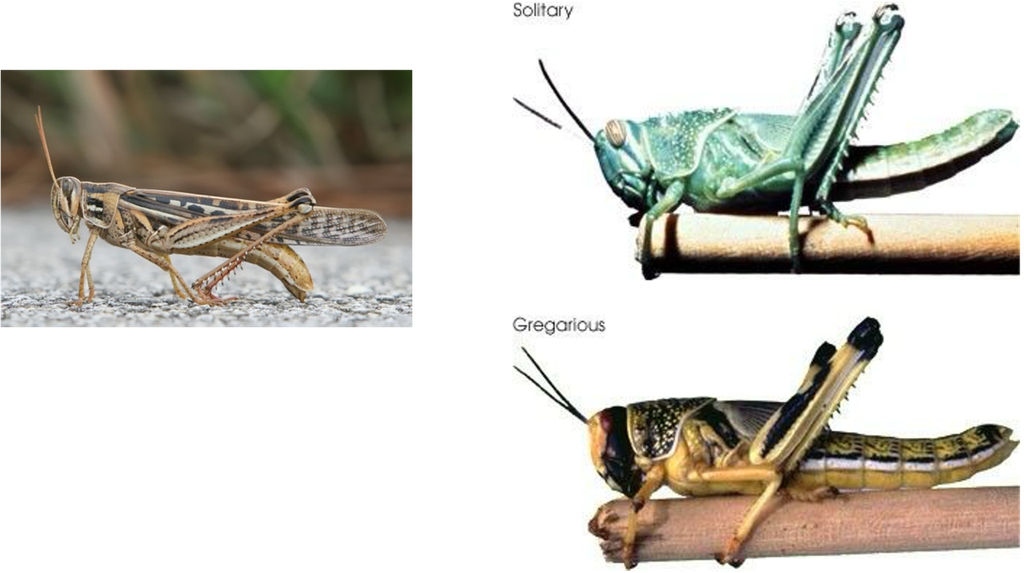
7. In arid areas that occasionally have prolonged heavy rainfall that results in a dramatic growth of dormant vegetation, locusts can change dramatically. Within days they can form a swarm of 200 billion locusts that cover an area of 30 miles x 30 miles. Such a swarm will eat 90 million tons vegetation/day, which is more food than the whole UK population eats in a year.
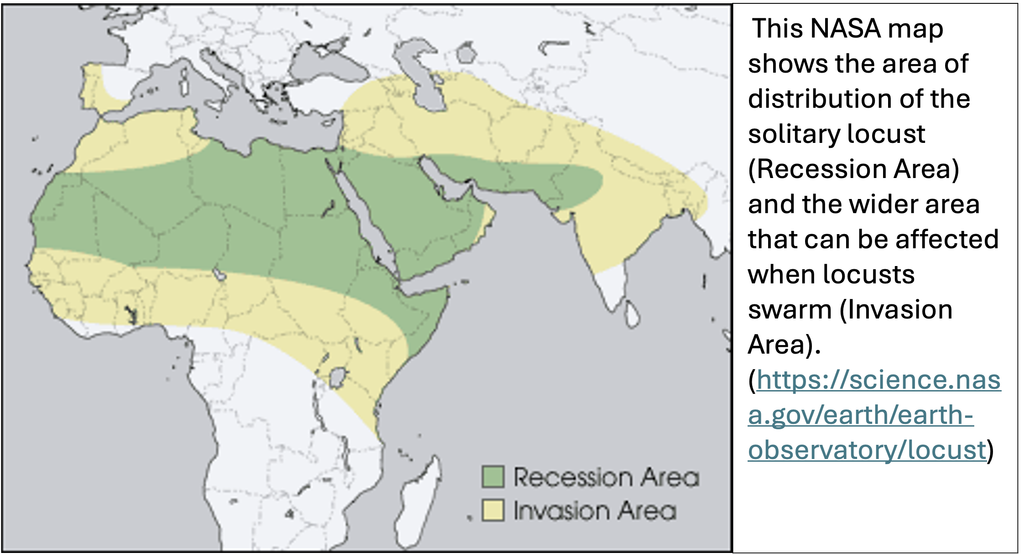
8. Joel’s plague and the Egyptian plague described in Exodus 10:1-20 were representative of the plagues that have continued throughout history in North Africa and the Sinai (with Israel at the top edge) spreading eastward to Southeast Asia.They feature quite extensively in Scripture.[1] In ancient times however, much of this land was far more fertile than it is currently so the climate was probably more Temperate than Dry.[2] If so, the calamitous event as described by Joel could genuinely have been very rare. North African locust swarms have been known to cross the Atlantic but each continent except Antarctica have their own locust plagues. They are very rare in Europe.
9. Locusts are a type of large grasshopper. They are 60 to 80 mm in length and chunky so are tasty snacks of nutritious protein (as John the Baptist knew – see Mark 1:6). When they swarm, they eat everything in sight: crops are devoured, trees are stripped of leaves and even the bark is removed: ‘It has stripped off their bark and thrown it away, leaving their branches white,’ (1:7). That of course will kill or seriously stump the tree’s growth.
10. Locusts do not seem to have many natural predators so locust invasions may continue for months or even years, and are limited, for example, by surrounding high hills or the sea, changing weather conditions or wind direction.
Poetry or prose?
11. Joel 3:4-8 stands out as in the NIV translation it is set out as prose and not poetry. It is not clear why and there is no footnote explanation.
12. The puzzle deepens when other versions are consulted. The Message and NKJV both have poetry throughout, but the line structure is different to mine. GNB, TEV, NLT, NASV are like NIV while NRSV has the prose section starting at 2:30 and CEV starts at 2:32. No translation has an explanatory note, nor do any have a prose sections elsewhere (except as mentioned in note 16).
13. All these layouts, like the chapter and verse layouts, are decided by the translators and are not necessarily part of Joel’s original creation. I think, therefore, that it is reasonable to see what results if this section is set out in a poetic structure like the rest of Joel.
14. I suggest:
| 4 ‘Now what have you against me, O Tyre and Sidon and all you regions of Philistia? Are you repaying me for something I have done? If you are paying me back, I will swiftly and speedily return on your own heads what you have done. 5 For you took my silver and my gold and carried off my finest treasures to your temples. 6 You sold the people of Judah and Jerusalem to the Greeks, that you might send them far from their homeland. 7 ‘See, I am going to rouse them out of the places to which you sold them, and I will return on your own heads what you have done. 8. I will sell your sons and daughters to the people of Judah, And they will sell them to the Sabeans, a nation far away.’ Yahweh has spoken. |
15. That appears to be a straightforward layout that is in keeping with the rest of the book so I have adopted it and, as it turns out, it is helpful in understanding the poetic layout.
16. It is easy to miss but Joel 1:1 is also prose and the final statement, ‘Yahweh rules in Zion!’ is set in the centre of the column out of step with all other lines. These are the translators’ choices and I can find no reason to think they are part of the Hebrew structure.
Joel’s themes
17. It looked to me that there were probably 4 themes in Joel that I suspected were distinct Messages. These were:
| Message 1 | 1:1-12 | Learning to cope with an extensive locust invasion |
| Message 2 | 1:13-2:17 | People’s response to the invasion |
| Message 3 | 2:18-27,32 or even 3:8 | Yahweh’s response |
| Message 4 | 2:28-, 3:1- or even 3:9-3:21 | Yahweh’s judgement on his people’s enemies and their victory and restoration |
18. Having analysed the poetic structure of about 30 psalms I had some idea of what to look for. Nevertheless, it took much trial and error, episodes of despair, prayer and actively listening for Yahweh’s guidance and inspiration before I was confident that it was possible to discern something about Joel’s mission to share the Messages Yahweh had given him for Yahweh’s people, so they were encouraged to trust Yahweh as they faced apparently overwhelming trauma and suffering.
19. I will skip over the false trails I followed and come to what I consider to be the themes of the Messages that Joel imparted to his people some 2,500 years ago. Joel’s teaching though was not only for Yahweh’s people in his generation. The teaching is bang up to date as it fits in with the troubles and fearful prospects facing Yahweh’s people throughout the world in 2026.
20. The themes of Joel’s four Messages (and note the divisions are now in different places) are:
| Message 1 | 1:1-15 | Lamenting a national catastrophe |
| Message 2 | 1:16-2:17 | Dealing with trauma |
| Message 3 | 2:18-3:8a | Yahweh’s heart: recovery and healing rather than retribution |
| Message 4 | 3:8b-21 | There is a good future for Yahweh’s people |
21. The poetic layout of each message is unique but it is what it is as it is a key part of the message. This is in keeping with what I have discovered in the Psalms. Admittedly I have published my findings on only 26 Psalms, 17% of the total of 150 Psalms (up to August 2026), but that is a statistically significant proportion and suggests, even if not all follow the same patterns, there is a good chance there are other patterns still to be discovered.
22. Consideration of who the author is, the circumstances in which he wrote and the reasons that seem to have been the inspiration are usually considered in an introduction but I am leaving these to the concluding section as virtually the only source of information about these topics are Joel’s Messages themselves.
Endnotes
[1] Other references to locust plagues are in Deuteronomy 28:38-42, 1 Kings 8:37, 2 Chronicles 6:28, 7:13, Psalm 105:34-5, Proverbs 30:27 and Amos 4:9, 7:1-2. They are referenced metaphorically in Judges 6:1-6, 7:12, Isaiah 33:4, Jeremiah 46:22-23, 51:14, 27, Nahum 3: 15-17 and Revelation 9:3, 7.
[2] For example, in Roman times the huge volume of grain that was needed to feed the million strong population of the city of Rome was imported largely from North Africa – the area we now know as Libya, Tunisia and Algeria – that has been desertified (Sahara Desert) for many centuries since then.
Written: 15 October 2026
Published: 15 October 2026
Click on the link to continue to Message 1