
Your word is a lamp to my feet and a light for my path. (Psalm 119:105)
Psalm 6 (NIV 1984)
For the director of music. With stringed instruments. According to sheminith. A psalm of David.
1 O LORD, do not rebuke me in your anger
	or discipline me in your wrath.
2 Be merciful to me, LORD, for I am faint;
	O LORD, heal me, for my bones are in agony.
3 My soul is in anguish.
	How long, O LORD, how long?

4 Turn, O LORD, and deliver me;
	save me because of your unfailing love.
5 No one remembers you when he is dead.
	Who praises you from the grave?

6 I am worn out from groaning;
	all night long I flood my bed with weeping
	and drench my couch with tears.
7 My eyes grow weak with sorrow;
	they fail because of all my foes.

8 Away from me, all you who do evil,
	for the LORD has heard my weeping.
9 The LORD has heard my cry for mercy;
	the LORD accepts my prayer.
10 All my enemies will be ashamed and dismayed;
	they will turn back in sudden disgrace.
Notes
1. David, the psalmist, is traumatised but the reason is not given. Psalm 6 focusses on his personal reaction to trauma and especially how it affects him physically. He describes his weeping that goes on all night long (6). He weeps so copiously his vision is blurred and he cannot see clearly (7).
2. His distress means he does not sleep so his body is not rested and he is ‘worn out’ (6) and feels faint (2). That would tend to happen when he stood up or tried to do anything. His, ‘bones are in agony’ (2) is a phenomenological way of describing the deep aching he would experience throughout his body because of muscular tension as a result of inadequate sleep.
3. The phraseology of verse 8 seems to suggest that, at last, David has caught Yahweh’s attention. But we know that is not true, for Yahweh, the Always I Am, is permanently available, attentive and aware of all that goes on in his creation – and that includes his people’s lives and their needs.The one thing that has changed, seemingly quite dramatically, is that David realises that Yahweh has heard his cry and accepts him (9). That gives him a different perspective on his situation. He is safe in Yahweh’s care whatever happens in his circumstances. That confidence inevitably changes his understanding of his enemy’s activities. They will be ‘ashamed and dismayed’ and in ‘disgrace’ (9). But note that is in the future – it has not yet happened. What has happened is David’s changed perspective.
4. The psalmist’s changed perspective describes a very common experience that happens when any believer goes through severe and prolonged traumatic experiences. It is an aspect of the journey of recovery from such crises so verses 8-10 are likely to be a core and original part of the Psalm and not a later edition as some commentators propose because of the abrupt change in tone.[1]
5. The little that is said about those ‘enemies’ seems to suggest they are not rival nations or renegades who are out to destroy the nation or usurp David’s role. He refers to them as those ‘who do evil’ (8) but no details are given. ‘Do evil’ translates awen, that is used 77 times in OT. NIV translates it into a variety of more than 20 English words ranging from evil and wickedness, to distress and hardship. It is the context that guides this interpretation. He wants them out of his life. ‘Away from me’ (8) he says, but all he expects is that they ‘will be ashamed and dismayed’ (10), and that will cause them to back off and go away, in ‘disgrace’ (10). I wonder, therefore, if these were people from within his community who had seriously fallen out with David.
6. If this ‘evil’ is only about a falling out some might think the psalmist’s expression of his distress is an over-reaction. However, the way we react to bad things is more than about the cause of trauma. If we are let down or treated badly by someone we know well, like and trust that can be harder to bear and will result in a more extensive reaction than when a stranger or an established ‘enemy’ hurts us.
7. This is supported, I think, by his opening comment (1) that suggests Yahweh could be displeased with him so was disciplining him. Perhaps he had a guilty conscience that he might be at fault for causing this rift.
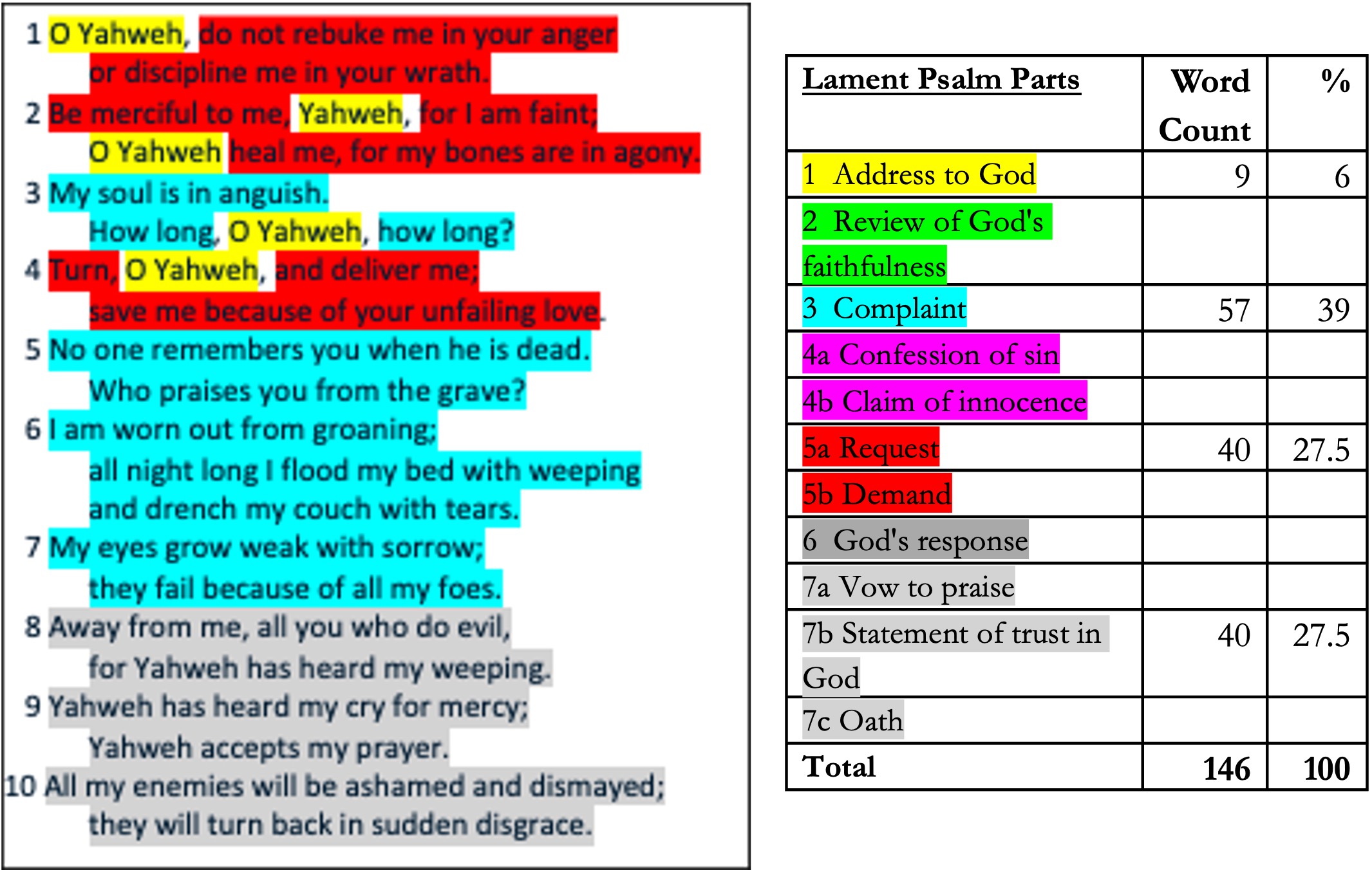
8. Psalm 6 is a lament, as shown in the table below. This features a complaint that Yahweh has neglected him (3) and that has contributed to him feeling ‘worn out’ (6-7). He can see no hope of recovery or rescue so feels that his life is coming to an end. He therefore reminds Yahweh that it is only if his life is spared that he can continue to worship (5). Unlike many other laments his complaint is presented without rancour or anger.
9. Yahweh, translated as, ‘LORD’ in most English versions, is how God is addressed throughout the OT. It is God’s name, not a title, and means something like ‘Always I Am.’ It is based on God’s nature, not on what he does.
10. Further insights are obtained when the psalm is set out in what was likely to be the original Hebrew poetic structure.
11. On the basis of the ideas expressed in each of the one-line strophes it appears there are two stanzas of unequal length. The theme of stanza 1 is the psalmist’s reflection on his suffering in which he comes to understand that Yahweh will respond to his prayers because of his ‘unfailing love,’ (4) and not because of the severity of his suffering (1) or its length (3). As a result David’s attention and attitude is changed so that is the theme of stanza 2. These are aspects of the overall theme of the psalm that teaches that awareness of the presence and care of Yahweh due to his unchanging love will change our attitude to oppressive trauma.
12. Each stanza is arranged in a chiastic structure with the key point in the centre (strophe X). Other strophes are arranged in pairs (A-A1 etc) with each part presenting an aspect of the same idea. Key matching words are in bold.
13. That the two stanzas are of unequal size is immaterial in the Hebrew poetic style.
Psalm 6 (NIV)
Being aware of the presence and care of Yahweh changes our attitude to oppressive trauma
| Stanza 1 | Yahweh’s unfailing love is the reason he rescues us from our sufferings | |
| A | 1 O Yahweh, do not rebuke me in your anger or discipline me in your wrath. | Suffering as punishment or discipline by Yahweh. |
| B | Be merciful to me, Yahweh, for I am faint; O Yahweh heal me, for my bones are in agony. | Physical effects of suffering. |
| C | 3 My soul is in anguish. How long, O Yahweh, how long? | Believes he deserves help as suffering has been prolonged. |
| X | 4 Turn, O Yahweh, and deliver me; save me because of your unfailing love. | Request for deliverance is based on Yahweh’s character. |
| C1 | 5 No one remembers you when he is dead. Who praises you from the grave? | He claims that Yahweh will ‘benefit’ if help is provided. |
| B1 | 6 I am worn out from groaning; all night long I flood my bed with weeping and drench my couch with tears. | Physical effects of suffering. |
| A1 | 7 My eyes grow weak with sorrow; they fail because of all my foes. | Suffering because of enemies. |
| Stanza 2 | Focus on Yahweh changes attitude | |
| D | Away from me, all you who do evil, for Yahweh has heard my weeping. | Enemies have no claim on him now he is covered by Yahweh’s acceptance. |
| X1 | 9 Yahweh has heard my cry for mercy; Yahweh accepts my prayer. | Yahweh responds to his desperate pleas. |
| D1 | 10 All my enemies will be ashamed and dismayed; they will turn back in sudden disgrace. | Yahweh’s help means David is vindicated and his opponents (‘enemies’) back off from their accusations. |
14. In stanza 1, David reflects on how his suffering affects him and wonders why he is suffering. He requests Yahweh’s help.
15. He starts in strophes A-A1 with some possible explanations for his suffering. In strophe A he wonders if his suffering is due to Yahweh’s ‘rebuke’ and ‘discipline’ and he begs him to stop.
16. This is paralleled in strophe A1 where he says his suffering is ‘because of all my foes,’ but no further details are given. ‘My eyes grow weak with sorrow’ is synecdoche, a figure of speech in which one aspect of his response to his suffering, the blurred vision due to his weeping, is used to represent his overwhelming sense of physical weakness.
17. In strophes B-B1 he appeals to Yahweh’s reputation for being ‘merciful’ as he focuses on the severity of his suffering especially the physical effects he was experiencing. He feels physically faint as if he were at risk of collapsing and in, ‘my bones are in agony,’ in strophe B he refers to the pain deep within his body that can be related to the muscular tension as he is not resting and sleeping well nor exercising much. However, this is not a factual statement expressing his understanding of anatomy and physiology but is poetic and phenomenological so needs to be understood as if the phrase was preceded by, ‘it feels as if.’
18. However, because David expresses himself in metaphors rather than in factual statements his description will resonate more easily with readers who have had similar symptoms. They will see themselves in David’s description so hopefully will then be ready to rejoice as David does as he recognises Yahweh’s role in his suffering. See more about biblical metaphors and other figures of speech in Introduction to Psalm Insights especially, ‘Window 3 – Metaphors.’
19. This imagery is developed in strophe B1 where ‘worn out’ and ‘groaning’ parallels ‘faint’ and ‘in agony’ in strophe B And then in,
all night long I flood my bed with weeping
and drench my couch with tears,
he emphasises how deeply he was affected by the unrevealed trouble that was the background to his suffering.
20. In strophes C-C1 he adds further reasons why he deserves Yahweh’s mercy in resolving his troubles. He moves from his physical complaints and refers in strophe C to his ‘soul,’ his inner being, his emotional state and mind, as reasons why he qualifies for Yahweh’s help, as he believes his sufferings has gone on long enough.
21. In the matching strophe C1 he seems to sense that his sufferings are so severe and prolonged that they could lead to his death. He reminds Yahweh that his ability to speak of Yahweh’s goodness and to worship will end at that point. This is poetry expressing a limited point so should be seen only as an argument ploy that does not infer any evidence of David’s or OT Scripture’s theological understanding of life after death.
22. All these symptoms are typical of the initial reaction to a severe traumatic experience and do not necessarily imply a physical illness. For further information see The Stages of Grief in The Journey of Grief toward Recovery and Healing.
23. In a chiastically arranged psalm the matching strophes build up related ideas to the climax with the main point in the centre. Sometimes, as here, it is a single line with no matching partner. The main point in stanza 1 is in strophe X where David senses the prime reason Yahweh answers prayer is ‘because of your unfailing love.’ That is as true today as it was then.
24. Having reflected on his suffering and considered some grounds why Yahweh might respond, David focuses on Yahweh’s character trait of ‘unfailing love’ as the key reason for his confidence. ‘Unfailing love’ translates hesed, that is variously translated as loving kindness, unfailing love, loyalty and mercy and a variety of similar words, but there is no hint of romantic love. Mounce says it is, ‘one of the richest, most theologically insightful terms in the OT.’ It may be used of human relationships but is most often used as a description of ‘the special relationship God has with his covenantal people.’[2] Key expressions of this are stated in:
Yahweh, Yahweh, the compassionate and gracious God, slow to anger, abounding in love (hesed) and faithfulness, maintaining love (hesed) to thousands, and forgiving wickedness, rebellion and sin. Yet he does not leave the guilty unpunished; he punishes the children and their children for the sin of the fathers to the third and fourth generation (Exodus 34:6-7).
Because of the Lord’s great love (hesed) we are not consumed, for his compassions never fail. Though he brings grief, he will show compassion, so great is his unfailing love (hesed) (Lamentations 3:22, 32).
25. Summarising the teaching elements of stanza 1, David tries to understand the causation and significance of his suffering:
a. He senses that his sufferings are a punishment from Yahweh (strophe A).
b. And that this has allowed his enemies to gain the upper hand (strophe A1).
c. He accepts that suffering is ‘normal’ but these particular sufferings are excessive (strophe B).
d. He recognises that he is dependent on Yahweh acting through mercy, which is undeserved favour (strophe B).
e. He has responded to his sufferings in a culturally acceptable way that shows his sorrow, regret or repentance, whichever is appropriate (strophe B1).
f. He has not been only physically affected, for his ‘soul,’ his inner being, is in ‘anguish’ and that is indicative of the severity of his suffering. He senses he is beyond his ability to cope (strophe C).
g. So he is beginning to think he might not survive. He reminds Yahweh that this means he, Yahweh, will no longer benefit from his worship (strophe C1).
h. His main point, that all this builds up to, is in strophe X, where he recognises that at the heart of his hope and expectation of deliverance he depends on Yahweh’s character trait of ‘unfailing love.’
26. As he grasps this core truth David moves on in Stanza 2 to reflect on his belief that Yahweh has heard his prayer. My initial assumption was that Yahweh had answered his prayer in the resolution of his trouble – but there is no mention of that. ‘Heard’ is not the same as ‘answered.’
27. In Strophe D he calls on his foes, ‘you who do evil,’ to stop bothering him as he recognises that Yahweh has responded to his cries and tears.
28. It seems his foes were aware of this change as he sensed they would ‘be ashamed and dismayed’ (strophe D1). There is no mention of them being destroyed or defeated so these foes do not appear to be renegades or an invading force. They seem more likely to be disaffected citizens who have fallen out or had a difference of opinion, of some seriousness though, with David. Whether that was about his personal or regal status is not clear as David only deals with his personal reaction.
29. There is certainly a dramatic change in the attitude displayed in stanza 2. The change is sudden and seemingly unexpected for he expected his enemies, ‘will turn back in sudden disgrace.’ However, all that seems to have changed is David’s attitude and awareness of Yahweh’s role and status.
30. At the centre of this stanza is strophe X1, the main teaching point. David realises that Yahweh does hear his people’s prayers and ‘accepts’ them in the sense that he responds positively, either answering them as requested or hoped for, or providing assurance of his presence and commitment to him and perhaps redirecting his prayers.
31. Most translations of strophe X1 keep it as a simple repetition such as, ‘Yahweh hears my plea, Yahweh accepts my prayer.’ It is only NIV and GNB that use the phrase ‘cry for mercy,’[3] that seems to imply that Yahweh responds to a particular style of prayer or form of words.
32. Yahweh loves his people’s prayers and the only ground for expecting an answer is given in strophe X in stanza 1 – it is Yahweh’s ‘unfailing love’ (see notes 18-19).
33. Yahweh ‘hearing’ or even ‘answering’ us should never be seen as a ‘reward’ or something we have ‘earned.’ Instead, it is a feature of Yahweh’s loving kindness. And answers do not necessarily mean that our circumstances are changed.
34. The main point of the psalm is very simple and yet I missed it until on my umpteenth revision! But now I think I understand why there is such a sudden transition from stanza 1 to stanza 2 (see note 3). David’s troubles have not been resolved, Yahweh has not changed nor has he intervened in David’s circumstances. And equally true, is that Yahweh was, is and always will be totally committed to his people’s needs and circumstances.
35. Only one thing has changed: David now realises the reality of who Yahweh is and what Yahweh’s commitment to his people really means. His focus therefore changes. He no longer is focussed on his sufferings, nor is he focussed on his opponents. He is not even focussed on how or when Yahweh will intervene to answer his prayers and resolve his troubles. Instead his focus is on Yahweh himself. What he knows intellectually and in theory is now being lived out in the turmoil of normal life.
36. Psalm 6, therefore, is all about having a fresh insight into how best to cope with traumatic experiences. It is to ensure our focus is on Yahweh. This description is commensurate with the ‘dwelling in Yahweh’ that is the topic of Psalm 91 and the ‘Persevere in Faith’ of Psalm 13.
Endnotes
[1] R. E. O. White, A Christian Handbook to the Psalms, (Exeter: The Paternoster Press, 1984), p. 33, Rev. Dr. A Cohen, The Psalms: Hebrew Text, English Translation and Commentary, (Chesham: The Soncino Press, 1945), p. 13.
[2] William D. Mounce, Mounce’s Complete Expository Dictionary of Old and New Testament Words, (Grand Rapids, MI: Zondervan, 2006), p. 426.
[3] And this is the only occasion that tehinna, usually translated as plea or petition, is translated as ‘cry for mercy.’
Written: 29 June 2016
Published: 18 January 2026
Revised: 5 February 2026