
Your word is a lamp to my feet and a light for my path. (Psalm 119:105)
Psalm 2 (NIV, 1984)
1  Why do the nations conspire
 	and the peoples plot in vain?
2  The kings of the earth take their stand
 	and the rulers gather together against the LORD
 	and against his Anointed One.
3  "Let us break their chains," they say,
 	"and throw off their fetters."
4  The One enthroned in heaven laughs;
 	the Lord scoffs at them.
5  Then he rebukes them in his anger
 	and terrifies them in his wrath, saying,
6  "I have installed my King
 	on Zion, my holy hill."

7  I will proclaim the decree of the LORD:

    He said to me, "You are my Son;
 	today I have become your Father.
8  Ask of me,
 	and I will make the nations your inheritance,
 	the ends of the earth your possession.
9  You will rule them with an iron sceptre;
 	you will dash them to pieces like pottery."

10 Therefore, you kings, be wise;
 	be warned, you rulers of the earth.
11 Serve the LORD with fear
 	and rejoice with trembling.
12 Kiss the Son, lest he be angry
 	and you be destroyed in your way,
     for his wrath can flare up in a moment.
 	Blessed are all who take refuge in him.
Introduction
1. Psalm 2 (NIV) is arranged in single line strophes, each with two parts, except verses 2 and 8 each have three parts and verse 7a has a single part and is set out as a separate stanza. I wonder if verse 7 should be seen as a single strophe with three parts as in NIV (2011), NRSV and MSG.
2. Initially the theme seems to be about a rebellion of nations and their leaders against Yahweh and his newly appointed King who is the rightful ruler of the whole world.
3. The first stanza describes Yahweh’s perspective on the futility of his created people’s rebelliousness toward himself and his chosen ruler.
4. In the second stanza Yahweh’s chosen one announces Yahweh’s plan. It is only a half-line, which is most unusual, so it may well not have been the author’s intention that it should be seen to be an independent stanza. In some translations such as NIV (2011), NRSV and MSG verse 7 is set out as a single line with three parts.
5. That blends into the third stanza in which he quotes Yahweh’s declaration to himself about his inheritance.
6. In the final stanza Yahweh’s anointed one continues to speak advising the rebellious leaders that they should cease rebelling and accept the lordship of Yahweh’s chosen king.
7. The psalm is referenced seven times in NT as prophetic about Jesus, the Messiah. Most translations emphasise this by using capitals as in, ‘Anointed One,’ ‘King’ and ‘Son.’
8. However, a messianic prophecy would not necessarily have been the intention of the psalmist. The original Hebrew did not have separate upper- and lower-case letters, nor did it have punctuation. These have been introduced by translators so promote that particular interpretation.
9. ‘The LORD’ is transposed to its original Yahweh in the following notes.
Psalm 2 and its biblical context
10. In Hebrew poetry each strophe promotes a single idea so beside each strophe in the following table is the message that I think the psalmist is seeking to impart.
| 1 Why do the nations conspire and the peoples plot in vain? | Describing the opposition as ‘nations’ and ‘peoples’ suggest the rebellion is widespread (worldwide?) even though it will be futile. |
| 2 The kings of the earth take their stand and the rulers gather together against Yahweh and against his anointed one. | Kings and rulers are collaborating in the rebellion and it is specifically against Yahweh himself and his chosen leader. |
| 3 “Let us break their chains,” they say, “and throw off their fetters.” | They appear to see themselves as slaves/prisoners. There seems to be no appreciation of Yahweh’s goodness and wisdom. |
| 4 The one enthroned in heaven laughs; the Lord (adonnay) scoffs at them. | Yahweh in heaven derides and mocks them. |
| 5 Then he rebukes them in his anger and terrifies them in his wrath, saying, | Yahweh’s anger and wrath are responsive – they are not an aspect of his nature. |
| 6 “I have installed my king on Zion, my holy hill.” | Yahweh‘s king is his ‘anointed one’ (2). He is Yahweh’s earthly representative and reigns from Jerusalem. The perfect tense suggests he is already in place. |
| 7 I will proclaim the decree of Yahweh: He said to me, “You are my son; today I have become your father. | The anointed one declares Yahweh’s decree about their relationship. |
| 8 Ask of me, and I will make the nations your inheritance, the ends of the earth your possession. | As son of Yahweh the chosen king has all humankind and the entire physical world as his own rightful possession. |
| 9 You will rule them with an iron sceptre; you will dash them to pieces like pottery.” | Yahweh declares that his son’s reign will be firm and strong and will brook no opposition. |
| 10 Therefore, you kings, be wise; be warned, you rulers of the earth. | The psalmist advises the rebel leaders to act sensibly. |
| 11 Serve Yahweh with fear and rejoice with trembling. | He advises obedient service (links with v2-3) characterised by both fear and pleasure. (why trembling?) |
| 12 Kiss the son, lest he be angry and you be destroyed in your way, | ‘Kiss,’ in this context, is an acted-out sign of obeisance. |
| for his wrath can flare up in a moment. Blessed are all who take refuge in him. | The son is unpredictable. Can ‘wrath’ have positive connotations? |
11. This layout probably reflects more closely what the psalmist had in mind when he composed the psalm. It now appears to be somewhat nationalistic about a ruler of Israel who is regarded by Yahweh as the ‘senior’ king over other national rulers. Not surprisingly, some commentators assume it is based on an historical king such as David, or perhaps an idealised king. However, it takes an international and perhaps even a world perspective so it is more than what would be expected in a purely nationalistic psalm.
12. If much of the psalm is accepted as hyperbolic, however, this psalm could relate to events that followed David’s capture of Jerusalem from the Jebusites after he became king of all Israel as recorded in 2 Samuel 5:1-9. The next section (verses 10-16) provides a summary of events over the next many years before reverting to an incident that seems to have occurred soon after David moved to Jerusalem, for it happened, ‘when the Philistines heard that David had been anointed king over Israel’ (verse 17).[1]
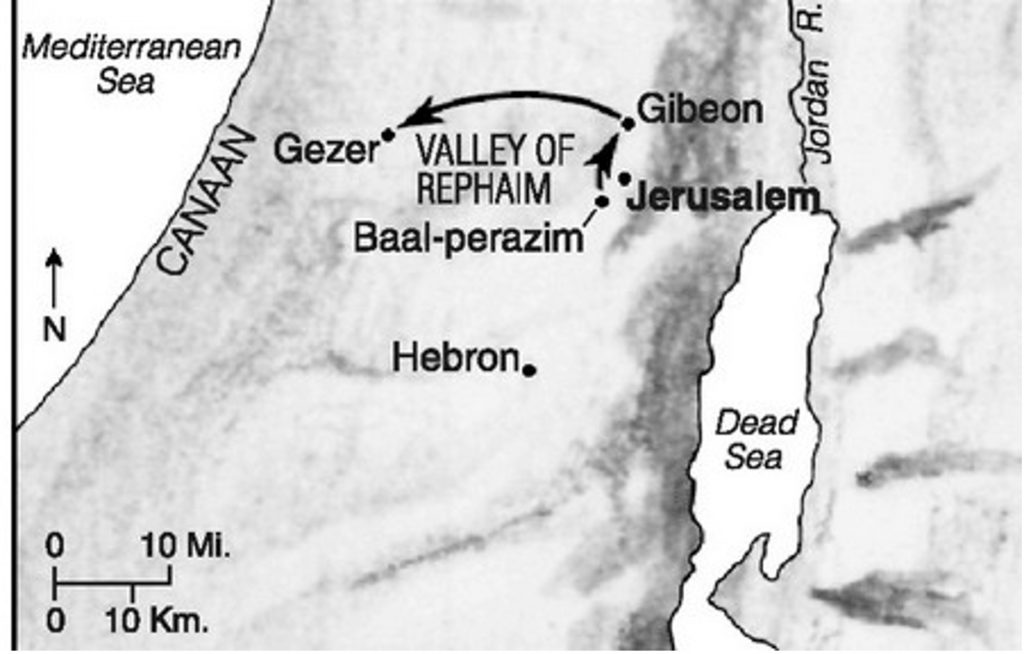
13. The Philistines twice approached Jerusalem through the Valley of Rephaim but were soundly defeated on both occasions and were chased out of the hill country back to Gezer, which was their own city at that time (verses 18-25).
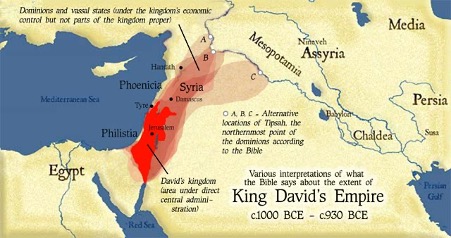
14. Admittedly these were relatively small skirmishes but the parallel account in 1 Chronicles 14:8-17 concludes with, ‘So David’s fame spread throughout every land, and Yahweh made all the nations fear him.’ We must understand, though, that ‘every land’ and ‘all the nations’ are used hyperbolically so refer to those countries that were relevant to the author as his ‘world’ and that could just mean from Egypt in the south to Assyria in the north and extending westwards to include Cyprus.
15. These comments raise the possibility that Psalm 2 was written in anticipation that David’s status and fame would continue and would even increase.
16. David could rightly claim to be Yahweh’s ‘anointed one’ (v. 2) as Samuel had anointed him as a youth at Yahweh’s command (1 Samuel 16:11-13), Judah, his own tribe, anointed him as their king after the death of Saul (2 Samuel 2:4) and seven years later he was anointed for the third time as national king (2 Samuel 5:1-5 and 1 Chronicles 11:1-3).
17. Very soon, it seems, after that third anointing, David captured the hilltop fortress-city of Jerusalem and made it his capital. That was an astute move as it was outside Judah, his own tribal area, so would enhance his standing among the other tribes and as Jerusalem had never previously been occupied by Israel it was independent of any tribal claims so truly was, ‘the city of David.’ In Psalm 2 Jerusalem is referred to as ‘Zion’ and 2 Samuel 5:7 that describes this conquest is the first time in Scripture the name Zion[2] is used.
18. Some years went by. David was victorious in battle after battle and eventually had a period of peace but being a man of action, he turned to another project – building a house of worship that was worthy of Yahweh to replace the tent that must have been thoroughly worn out after more than 200 years of daily use. Nathan the prophet agreed but that night Yahweh spoke to Nathan with a message for David (2 Samuel 7:4-17). Here is a summary of the main points that relate to Psalm 2:
| 2 Samuel 7:4-17 | Psalm 2 |
| I took you … and appointed you ruler over my people Israel (8). | “I have installed my King on Zion, my holy hill.” (6) |
| I have been with you wherever you have gone (9). I have cut off all your enemies from before you (9). | Why do the nations conspire and the peoples plot in vain?(1) |
| I will make your name great (9). I will also give you rest from all your enemies (11). I will establish a house for you (11). I will raise up your offspring to succeed you … and I will establish his kingdom (12). I will establish the throne of his kingdom forever (13). Your house and your kingdom will endure forever before me (16). Your throne will be established forever (16). | I will make the nations your inheritance, the ends of the earth your possession. (8) |
| I will be his father, and he shall be my son (14). | “You are my Son; today I have become your Father. (7 |
19. The next step[3] toward understanding the author’s intention is to identify the parallels between lines.
20. Some Bible commentors[4] note the parallels between the first and last of four divisions: verses 1-3 (rebellious human rulers) and verses 10-12 (Yahweh’s anointed ruler) and between the middle two divisions: verses 4-6 (Yahweh rules from heaven) and verses 7-9 (The one Yahweh has anointed is his representative on earth).
21. The psalm consists of an odd number of one-line strophes (there are two in verse 12). That three strophes consist of three parts rather than the usual two, appears to be incidental.
22. These two points suggests the Psalm has a chiastic structure. The following layout and notes show the parallels in more detail. The parallels are primarily in contrast and development rather than in similarities and repetition so that explains why they are not as obvious as in other psalms. Amazingly and appropriately, the emphasis throughout is now all about Yahweh and his anointed, and much less about the rebels.
23. The conversational aspects of the psalm appears to be inconsequential in understanding its poetic structure.
24. I suspect this is how the Psalm would have been understood in its original format. The key words are in bold script.
Psalm 2 – Probable poetic structure
| Stanza 1 | Yahweh’s rebellious people object to his choice of their king | |
| A | 1 Why do the nations conspire and the peoples plot in vain? | Rebellion is doomed to fail. |
| B | 2 The kings of the earth take their stand and the rulers gather together against Yahweh and against his anointed one. | In spite of that futility the rebels persist in their plans to oppose both Yahweh himself and his chosen ruler. |
| C | 3 “Let us break their chains,” they say, “and throw off their fetters.” | The rebels see Yahweh’s care, supervision and control as restrictive as if they were slaves or prisoners. |
| Stanza 2 | Yahweh’s response | |
| D | 4 The one enthroned in heaven laughs; the Lord (adonnay) scoffs at them. | Yahweh’s status as heavenly ruler and lord is emphasised as his attitude of mocking derision toward the rebellion is described. |
| E | 5 Then he rebukes them in his anger and terrifies them in his wrath, saying, | Failing a positive response to Yahweh’s overtures, Yahweh acts in overwhelming power in retribution. |
| F | 6 “I have installed my king on Zion, my holy hill.” | As a symbol of his power and status his chosen king will rule from Jerusalem. |
| Stanza 3 | A formal proclamation | |
| X | 7 I will proclaim the decree of Yahweh: He said to me, “You are my son; today I have become your father. | At the heart of Yahweh’s plan for ruling, controlling and overseeing his possessions is his son acting as his representative with full authority. ‘Proclaim’ and ‘decree’ suggest this is a formal announcement that all should hear and heed. |
| Stanza 4 | Yahweh’s plan for his world | |
| F1 | 8 Ask of me, and I will make the nations your inheritance, the ends of the earth your possession. | As son of Yahweh the chosen king sees both the human race and the entire physical world as his own rightful possessions. |
| E1 | 9 You will rule them with an iron sceptre; you will dash them to pieces like pottery.” | He emphasises his intention to rule in power and with discipline and, if necessary, with overwhelming fury. |
| D1 | 10 Therefore, you kings, be wise; be warned, you rulers of the earth. | His recommended response is that the earthly rulers take notice and act wisely. |
| Stanza 5 | Yahweh the refuge | |
| C1 | 11 Serve Yahweh with fear and rejoice with trembling. | Yahweh acknowledges the reality of their subservient status so advises they treat him with respect and obedience (fear) but do so happily (rejoice) knowing that Yahweh has only their good at heart. ‘Trembling’ is linked with rejoice rather than fear so should be understood to be a positive and pleasing feature. |
| B1 | 12 Kiss the son, lest he be angry and you be destroyed in your way, | Yahweh is patient and invites them to bow in homage to Yahweh’s chosen leader/king who is revealed to be his son. |
| A1 | for his wrath can flare up in a moment. Blessed are all who take refuge in him. | The reason rebellion is so foolish is that Yahweh is utterly powerful but equally, he will accept all who turn to him, acknowledge his lordship and seek his protection. |
25. Now to examine each strophe in this poetic context. This contrasts with ‘Psalm 2 and its biblical context’ where each strophe is considered in isolation.
Stanza 1 Yahweh’s rebellious people object to his choice of their king
26. This poetic layout changes the focus in strophe A from the rebellion itself that might engender a sense of despair, fear or worry, to surprise and sadness that anyone could contemplate engaging in such a futile endeavour. That is achieved by introducing the rebellion with a rhetorical question: ‘Why?’ It ends with the declaration that the rebellion is ‘in vain.’ All that follows has to be seen in this context.
27. Strophe B tells us the rebellion is personal. It is ‘against Yahweh and his anointed one’ but the poetic repetition of ‘against’ introduces a close link between Yahweh and his anointed. They are as one. There will be no chance of ‘divide and rule’ even though this is a powerful enemy – ‘the kings of the earth.’ That immediately leads us to see the messianic import, but I still suspect this was not the author’s initial intention. I think he was referring to David, the thrice anointed King!
28. Strophe C reveals that all the rebels see of Yahweh’s control leads them to believe that they are prisoners or slaves, restricted by metaphorical ‘chains’ and ‘fetters’ (meaning manacles/handcuffs and leg irons). They do not see, or choose to ignore, the evidence there would have been of Yahweh’s care, supportive control and protection. And notice they refer to Yahweh and his anointed together, so they were fully aware that Yahweh already had his chosen king.
Stanza 2 Yahweh’s response
29. Describing Yahweh as ‘the one enthroned in heaven’ and ‘Lord’ that translates adonnay meaning ‘Master’ (strophe D) emphasises Yahweh’s superior status above the ‘kings of the earth.’ Yahweh is the Almighty, who is all-powerful, as that title suggests. This reinforces the futility of rebellion. Yahweh’s laughter and scoffing are not to be taken as evidence of disdain, rejection or mockery. Yahweh’s essential character is of love, compassion and concern (see for example Deuteronomy 29:1-30:20 and Hosea 11:1-11) so this reaction is responsive, reflecting his shock, grief, disbelief and horror at the kings’ foolishness.
30. So naturally, if there is no response to Yahweh’s overtures of friendship and compassion, Yahweh responds with anger and wrath in strophe E. This again is responsive. It is not an innate feature of Yahweh’s character. Even here its primary goal is to obtain obedience and cooperation. No one, then or now, can rebel against Yahweh with impunity.
31. As evidence of Yahweh’s power and compassion (strophe F) he had set up his own king, his human representative, in Jerusalem, the city that had recently been captured and had become the capital of Yahweh’s chosen people who were his representatives on earth (e.g. Genesis 12:2-3, Exodus 19:3-6).
32. This was a significant development. To emphasise this, Jerusalem is denoted with its alternative name of Zion.
33. To us this is clearly a reference to Jesus as the Messiah but I doubt that would have been what the author had in mind. I suspect he genuinely thought this related to the new king David who had stunningly captured what had appeared to be an impregnable hill-top, city-fortress and made it his capital and then had soundly beaten back and subdued the Philistine enemies that had been the bane of the people’s lives for some decades (2 Samuel 5:6-25).
34. Notice too that the perfect tense is used, ‘I have installed.’ In the English language that means the installation has already happened – that is, it refers to the recent accession of King David.
35. However, there is more depth to this meaning as the Hebrew language is not strongly time dependant as is English, where the main verbs are Past, Present and Future and the Perfect Past indicates completion (and the Imperfect implies a continuing action). Essentially, Hebrew has two tenses, the Perfect, which denotes a completed action, and the Imperfect, which denotes an incomplete or ongoing action. It is the context that enables translators to choose the correct English tense. That means that this phrase can rightly be taken to refer to a future fulfilment as the Hebrew perfect tense is a valid way of expressing certainty about an event that has not yet happened but will take place.[5]
Stanza 3 A formal proclamation
36. Stanza 3 consists of the single strophe X that is so labelled as it is at the chiastic centre of the psalm and is the main point.
37. It is a ‘decree’ that is ‘proclaimed’ indicating it is an official authoritative announcement of major significance.
38. ‘Today I have become your father,’ suggests adoption is at the heart of the relationship rather than generative or eternal sonship so that fits with David being its primary reference.
39. Interestingly, when it is quoted by Paul in Acts 13:33 in his message at the Pisidian Antioch synagogue it is taken to refer to Jesus’ resurrection. In Hebrews 1:5 it is quoted to indicate that Jesus’ status was different and far superior to that of angel messengers. It is only in retrospect that it can be understood as a messianic reference.
40. The first half of the psalm has introduced Yahweh’s chosen king and after the proclamation the second half is about his kingdom rule. The rebellion is only incidental to the psalm’s main message.
Stanza 4 Yahweh’s plan for his world
41. Firstly, in strophe F1, the promise of a king in Jerusalem (strophe F) is extended. Yahweh declares the potential extent of his heir’s kingdom – as son of Yahweh, the chosen king, he has both the human race and the entire physical world as his own rightful possession. This is way beyond anything that David could have expected or seems to have imagined based on Yahweh’s promise via Nathan in 2 Samuel 7:4-17 (note 18). In the narratives of David’s life he appears to have been content with ruling Israel, defeating invading forces and extending Israel’s boundaries within the limits Yahweh had set (Deuteronomy 11:24, 34:1-3). There is no hint that he had aspirations to conquer other nations so we can only surmise that David never asked for this as he was encouraged to do: ‘ask of me…’. Perhaps, after all, David was aware of his shortcomings (see Psalm 21, for an example of these).
42. However, this statement is true as a prophecy about Jesus the Messiah. Scripture is clear:
… the Lamb will overcome them because he is Lord of lords and King of kings (Revelation 17:14).
Endow the king with your justice, O God, … He will rule from sea to sea and from the River to the ends of the earth (Psalm 72:1, 8).
Therefore God exalted him to the highest place and gave him the name that is above every name, that at the name of Jesus every knee should bow, in heaven and on earth and under the earth, and every tongue confess that Jesus Christ is Lord, to the glory of God the Father (Philippians 2:9-11).
43. Strophe E1 matches strophe E with an emphasis on Yahweh’s anointed ruler’s intention to rule in power and with discipline and, if necessary, with overwhelming fury.
44. In the context of Scripture’s emphasis on Yahweh’s character and intentions this should not be taken to contradict his passionate love, mercy, patience and grace (Exodus 34:6-7). It is here to emphasise that Yahweh has the ultimate authority and has the ability and commitment to act when he decides to do so. So, the generic word ‘staff’ that refers to a walking pole but is used in the context of ‘rule’ and ‘iron,’ is rightly interpreted as ‘sceptre,’ a symbol of authority. Being made of ‘iron’ rather than the usual wood develops the metaphor to emphasise Yahweh’s power.
45. This statement provides a fresh connection with the mocking abuse of Jesus by the Roman soldiers at his trial for, ‘they put a staff in his right hand and knelt in front of him and mocked him. “Hail, king of the Jews!” they said’ (Matthew 27:29). Their insults were intended to belittle and shame Jesus but their actions expressed a truth that has resounded around the world as the gospel has been proclaimed. Jesus is Yahweh’s annointed Messiah and Ruler of all Yahweh’s domains.
46. Vessels for eating, drinking and storage made from ‘pottery’ which is baked clay were ubiquitous throughout the Middle East for many centuries.[6] They were easily broken so the metaphor, ‘dash them to pieces like pottery’ is used to indicate that any opposition to Yahweh is fundamentally fragile and inconsequential.
47. In strophe D1 the psalmist concludes that the logical response by the world’s rulers is to exercise wisdom and take Yahweh’s attitude and abilities (strophe D) into account.
Stanza 5 The Refuge
48. In the final stanza the psalmist turns away from the negativity of the rebels to some positive features of Yahweh’s plans for his kingdom rule.
49. Strophe C1 acknowledges the reality of the nations and their rulers’ subservient status that the rebels objected to in Stanza C, so advises they treat Yahweh with respect and obedience (fear) but to do so happily (rejoice) knowing that Yahweh has only their good at heart. ‘Trembling,’ is a well-recognised physiological response to both joyfulness and fear so, as it is linked with rejoice rather than fear, it should be understood to be a positive and pleasing feature. It emphasises the richness and depth of their joy.
50. ‘Fear’ translates yare that can equally be translated as awe, reverence or worship and at the other extreme it can mean dread or terror. It is the context that guides interpretation[7] so here its meaning covers the full spectrum. Our personal understanding depends on whether we are willing followers of the Messiah and worshippers of Yahweh or are doomed rebels.
51. The phrase, ‘kiss the son’ in strophe B1, is best understood as a metaphor for a humble approach based on the custom to bow in homage and kiss feet or a proffered hand as a sign of respect, honour, obeisance or worship (Job 31:27, Hosea 13:2, Luke 7:37-46). That is the proper way to approach Yahweh’s son, his anointed representative. Honouring the Son (now I use a capital!) is the same as honouring Yahweh. And that contrasts with the aggressive rebelliousness of the kings and rulers in strophe B.
52. That is reemphasised in strophe A1 for Yahweh’s ‘wrath can flare up in a moment.’ This is not about capriciousness but rather reflects an awareness that Yahweh and his Messiah rightly expect unquestioning obedience. The psalm ends with, ‘blessed are all who take refuge in him.’ Yes! Yahweh is the ultimate authority and warrants our humble committed worship and service but at heart, Yahweh is a God of compassion and love who calls his people into his protective care. This is at the heart of Yahweh’s character and answers resoundingly the ‘in vain’ question ‘why?’ of strophe A.
Pulling it together
53. I think this psalm expresses the understanding David and the godly people of his generation had about Yahweh and his relationship with David, who was chosen by God and anointed by God’s people to be their earthly ruler and Yahweh’s representative.
54. With this seemingly obvious relationship with King David, see notes 11-18 especially, it is curious that it is not labelled as a ‘Psalm of David’ nor is it linked to the relevant Scripture texts such as 2 Samuel 7:4-17.
55. Some features are definitely ‘over the top’ expressing unrealistic goals for David (‘the nations your inheritance, the ends of the earth your possession’) but not at all for Yahweh’s offer (‘ask of me’).
56. Perhaps the ancient editors sensed that the Psalm was describing something that no earthly king, including David, could possibly imagine becoming reality so it was accepted that it would be invidious and even blasphemous to refer to it as a ‘Psalm of David.’ I see the hand of Yahweh in this as it powerfully illustrates 2 Timothy 3:16, ‘All Scripture is God-breathed ….’
57. So, quite understandably, it is quoted seven times in NT:
– Acts 4:25-26 where verses 1-2 are quoted in a prayer of the new believers as they experienced God’s powerful intervention and guidance when they stood up to the Sanhedrin’s opposition.
– As Paul preached in the synagogue in Pisidian Antioch he quotes verse 7 (Acts 13:33) relating it to Jesus’ resurrection.
– Hebrew 1:5 quotes the same verse as evidence for recognising that Jesus was far superior to angels.
– Psalm 2:7 is again quoted in Hebrews 5:5 in a section that explain how Jesus, the Son of God, can be seen as a great high priest who acts as an intermediary interceding on our behalf with God.
– There are three references in Revelation that all quote or refer to strophe E1 (verse 9). Revelation 2:27 quotes all the strophe as Jesus, the ‘Son of Man’ gives John a message for the church in Thyatira in which he promises that his followers who ‘overcome’ will undertake this leadership role. That fits in with, ‘we are heirs – heirs of God and co-heirs with Christ,’ (Romans 8:17) and ‘we will also reign with him,’ (2 Timothy 2:12).
– In Revelation 12:5 he alludes to it in a description of a vison of a woman who gives birth to a son, ‘who will rule all the nations with an iron sceptre’ (thus linking Psalm 2 to the glorified Jesus).
– Finally in Revelation 19:15 in a section that uses the imagery of a rider on a white horse to describe Jesus’ just rule, he quotes the first part only, to emphasise his overwhelming power and authority.
58. Psalm 2 is indeed the proclamation of Yahweh’s Chosen and Anointed King, the Messiah, so capitalisation of key words (see note 7) is a valid translation tool.
59. This may well have been one of the Scriptures that were on the minds of the crowds in Jerusalem as Jesus entered on a donkey for, ‘See your king comes to you,’ were included in a quotation from Zechariah 9:9, that they shouted out (Matthew 21:1-11). It seems conceivable that many on that day expected Jesus to take control and become king. So when all such dreams and hopes were shattered as Jesus was crucified their faith in Yahweh’s revelations and promises would have been in tatters. This is a reminder that any particular prophecy is only a partial picture, a hint, about what Yahweh will ultimately reveal. They are not given to provide inside knowledge or to enable us to further our own agenda as the mother of James and John tried to do (Matthew 20:20-21). Instead they are intended to encourage our faith, to comfort us in trials and to give us Yahweh’s shalom peace.
60. Psalm 2 does, I think, attempt to bridge the gap between eternity and time and that is helped by the way the Hebrew language uses verbs (notes 34-35). For example, in a ‘timely’ interpretation the Psalm fails as the proclamation of the Messiah as Lord of all Yahweh’s domains was never fufiled either in David or in Jesus’ life on earth. So God’s people are disappointed and may feel let down – we have to wait for fulfilment in the future (as we see it).
61. However, time is something Yahweh created and Yahweh lives outside of his creation. It is as if, for Yahweh, time is always now – and that concept is at the heart of the meaning of our God’s name of Yahweh – ‘the Always I Am.’ In eternal terms, it is as if Jesus death and resurrection were happening now. It is the reason why the saints of old are ‘saved’ by the sacrifice of Jesus as much as we are (‘the sacrifice of Jesus once for all …. by one sacrifice he has made perfect for ever those who are being made holy,’ Hebrews 10:10, 14).
62. Eternity is like a ‘parallel universe’ that is alongside our time and on occasion interacts with it: so the Son of God became human and lived among us in Jesus (John 1:14), Yahweh, or Jesus, appears to some (for example, Genesis 12:7, 1 Kings 3:5, Acts 9:3-6) and the resurrected Jesus had a normal body but could pass through walls (John 20: 26-27).
63. Hence, in terms of eternity, Psalm 2 makes absolute sense. We know that one day time will be absorbed into eternity. We will no longer be constrained by ‘time’ so all will then become clear (1 Corinthians 13:12). I think this understanding helps appreciation of Psalm 2. I think this is what Willem VanGemeren refers to when he says, ‘… the Psalter encourages an eschatological reading.’[8]
References
[1] Rev. Dr. A. Cohen, The Psalms: Hebrew Text, English Translation and Commentary, (Chesham: The Soncino Press, 1945) p. 3, draws attention to this as something that is recognised by many Jewish Bible scholars.
[2] ‘Zion’ means ‘citadel’ so primarily refers to the hill-fortress at the heart of Jerusalem where the tabernacle, and later, the Temple, were sited. Hence it came to be used metaphorically for the city of Jerusalem both in Scripture and then in Christian hymns especially with reference to its theological status. See Roland de Vaux, Ancient Israel: Its Life and Institutions, trans by John McHugh, (Trowbridge, Wilts.: Darton, Longman and Todd Ltd., 1973), pp. 326-328.
[3] For more information about Hebrew poetic structure see ‘Introduction to Hebrew poetry’.
[4] See for example Willem A. VanGemeren, ‘Psalms’ in The Expositor’s Bible Commentary, Vol 5 Revised Ed, ed. by Trumper Longman III & David E. Garland, (Grand Rapids, MI: Zondervan, 2008), p. 89 and Walter Brueggemann, The Message of the Psalms, (Augsburg, MI: Augsburg Old Testament Studies, 1984), pp. 32-33.
[5] This is, of course a simplification of Hebrew verbal use. A useful introduction to understanding something of the Hebrew language is Lee M. Fields, ‘Hebrew for the Rest of Us: Using Hebrew Tools without Mastering Biblical Hebrew,’ (Grand Rapids, MI: Zondervan, 2008).
[6] A. R. Millard, ‘Potter, Pottery,’ in J. D. Douglas and others, (Ed.) The Illustrated Bible Dictionary, (Leicester: Inter-Varsity Press, 1980), pp. 1248-1254.
[7] Ancient Hebrew has about 9,000 words whereas modern English has around 600,000 word-forms of which 170,000 are in common use. Hence, ‘like for like’ has a limited role in biblical translation and recognising the context is crucial.
[8] Willem A. VanGemeren, ‘Psalms’ in The Expositor’s Bible Commentary, Vol 5 Revised Ed, ed. by Trumper Longman III & David E. Garland, (Grand Rapids, MI: Zondervan, 2008), p. 98.
Written: 1 August 2021
Published: 19 December 2025